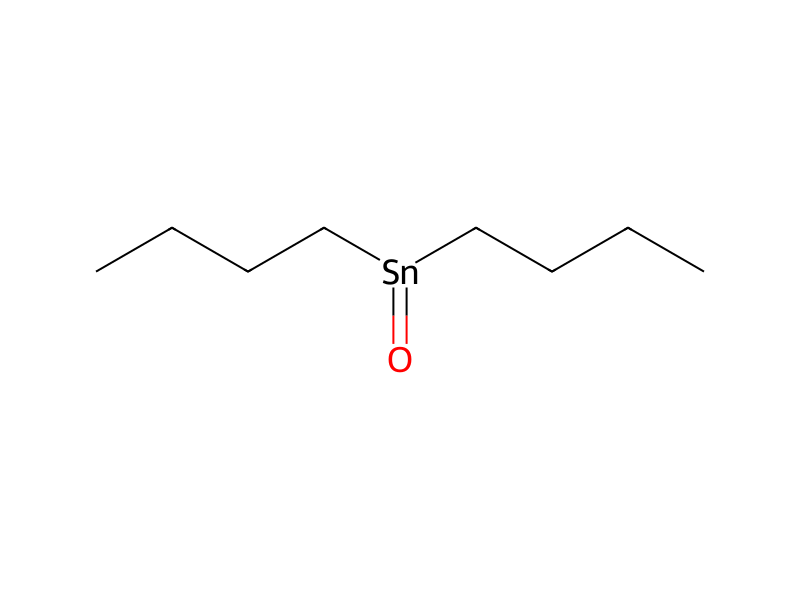
Dibutyltin oxide → HCID 59487992, 화합물
반응식

[CH2:1]([Sn:5](=[O:10])[CH2:6][CH2:7][CH2:8][CH3:9])[CH2:2][CH2:3][CH3:4].[OH:11][C:12]([C:23]1[CH:28]=[CH:27][CH:26]=[CH:25][CH:24]=1)([CH2:21]O)[C:13]([C:15]1[CH:20]=[CH:19][CH:18]=[CH:17][CH:16]=1)=[O:14]>C1(C)C=CC=CC=1>[CH2:1]([Sn:5]1([CH2:6][CH2:7][CH2:8][CH3:9])[O:11][C:12]([C:13](=[O:14])[C:15]2[CH:20]=[CH:19][CH:18]=[CH:17][CH:16]=2)([C:23]2[CH:28]=[CH:27][CH:26]=[CH:25][CH:24]=2)[CH2:21][O:10]1)[CH2:2][CH2:3][CH3:4]참가 물질
4



실험 절차
In a 50 ml dry three-neck-flask 2.1 g (8.3 mmol) of dibutyltin oxide, 2.0 g (8.3 mmol) of 2,3-dihydroxy-1,2-diphenyl-propan-1-one [prepared according to H. J. Hageman, Macromolekulare Chemie, Rapid Communications (1981), 2(8), 517-521] and 20 ml of toluene are heated to reflux under argon flow. A small amount of water is distilled off the clear solution. According to the 1H-NMR-spectrum the conversion is complete after 2 h. The solution is concentrated and the crude product (4.0 g) is recrystallized from 15 ml of cyclohexane. The white crystals (2.3 g) are recrystallized from 10 ml of heptane and 3 ml of cyclohexane. 1.6 g of the title product is obtained as a white powder melting at 140-145° C. The structure is further confirmed by 1H-NMR and 13C-NMR-spectra.