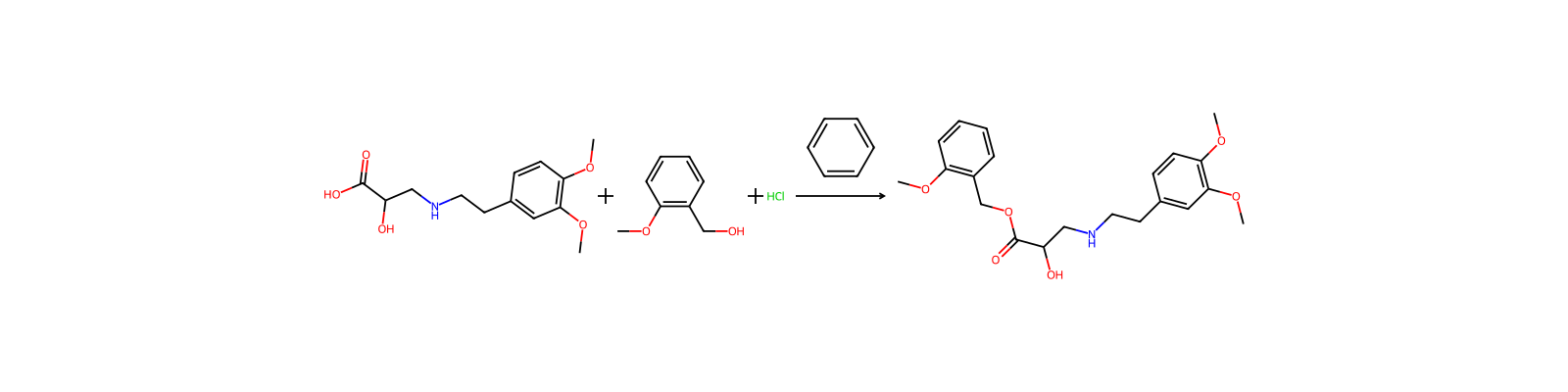
[CH3:1][O:2][C:3]1[CH:4]=[C:5]([CH:15]=[CH:16][C:17]=1[O:18][CH3:19])[CH2:6][CH2:7][NH:8][CH2:9][CH:10]([OH:14])[C:11]([OH:13])=[O:12].[CH3:20][O:21][C:22]1[CH:29]=[CH:28][CH:27]=[CH:26][C:23]=1[CH2:24]O.Cl>C1C=CC=CC=1>[CH3:1][O:2][C:3]1[CH:4]=[C:5]([CH:15]=[CH:16][C:17]=1[O:18][CH3:19])[CH2:6][CH2:7][NH:8][CH2:9][CH:10]([OH:14])[C:11]([O:13][CH2:24][C:23]1[CH:26]=[CH:27][CH:28]=[CH:29][C:22]=1[O:21][CH3:20])=[O:12]To 3 g of the 3-(3,4-dimethoxyphenethyl)amino-2-hydroxypropionic acid prepared in Example I was added 200 ml of benzene and 20 ml of 2-methoxybenzyl alcohol. About 0.5 ml of concentrated HCl was added to catalyze the reaction. The reaction mixture was heated to reflux for 6 hours and the water was collected by a moisture trap. The reaction mixture was extracted with 200 ml of 0.5% HCl in water. The aqueous layer was basified with NaHCO3 and extracted with CHCl3. Evaporation of the CHCl3 gave an oily residue which after chromotography on a column (silica gel/Et2O:EtOH=5:1) gave 1 g (23%) of white solid: m.p. 79.5°-82.5° C. The NMR, IR and mass spectra were consistent with the assigned structure and the elemental analysis was consistent with the empirical formula C21H27O6N.