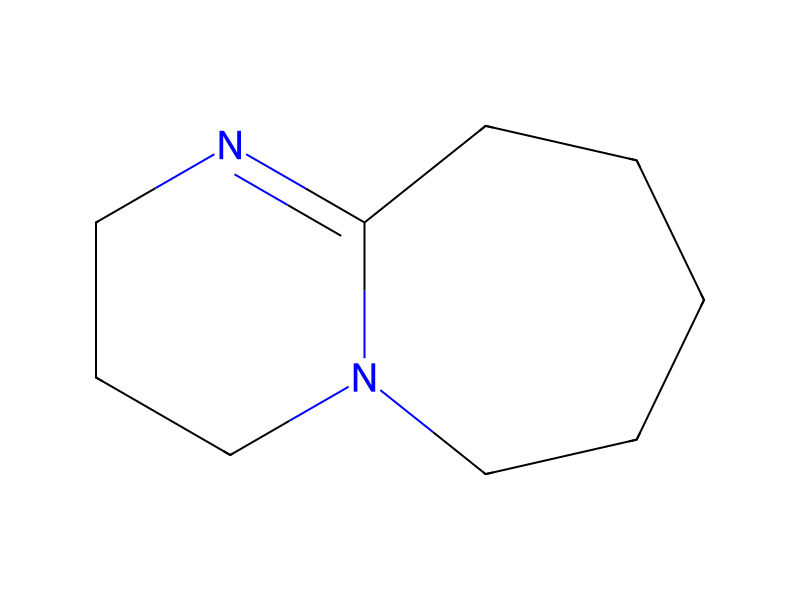
All the GC area % values in 3 hours were low, suggesting that the reaction was sluggish even at 140° C. and in the presence of catalysts. When 4 mol % of TBAB was used as the catalyst in Batch 2, the GC area % of bis(3-triethoxysilylpropyl)fumarate decreased from 10.8% in 3 hours to 5.0% in 18 hours. This resulted from quick degradation of TBAB in the first 3 hours at 140° C., as evidenced with a strong GC signal of the degradation product, tributylamine. Thus, TBAB was not a suitable catalyst for synthesis of bis(3-triethoxysilylpropyl)fumarate under these conditions. In the non-polar solvent, mineral spirit, in Batch 1, the reaction rate was further reduced as the GC area % was only 4.2% after 3 hours. Thus, a non-polar solvent was deemed detrimental to the reaction rate under these conditions. When the high temperature catalyst TBPB was used in Batch 5, the conversion was comparable to that of TBAB in 3 hours, but much higher than that of TBAB in 18 hours, indicating that TBPB was a better catalyst than TBAB for preparation of bis(3-triethoxysilylpropyl)fumarate under these conditions. DBU gave similar GC area % as TBPB in both 3 and 18 hours in Batch 3, suggesting that DBU was as efficient as TBPB. When 2 mol % of DBU octyl bromine quat was used as the catalyst in Batch 6, the conversion was low in 3 hours, but higher than those of DBU and TBPB in 18 hours. Without wishing to be bound by theory it is thought that there probably was an activation mechanism for DBU octyl bromine quat, and once activated, it was more efficient than DBU and TBPB. The most significant conversion gain in this example was achieved by doing the DBU-catalyzed reaction in the high polarity aprotic solvent, DMF, in Batch 4. There was a marginal lead of the GC area % in 3 hours and a remarkable superiority in 18 hours. Without wishing to be bound by theory, it is thought that the high GC area % in 18 hours could be attributed to an increased reaction rate, and a reduced association of bis(3-triethoxysilylpropyl)fumarate and CPTES with the solid salts in DMF. Therefore, it is thought that a high temperature catalyst, a polar aprotic solvent, or a combination thereof, can be used to improve the reaction conversion.