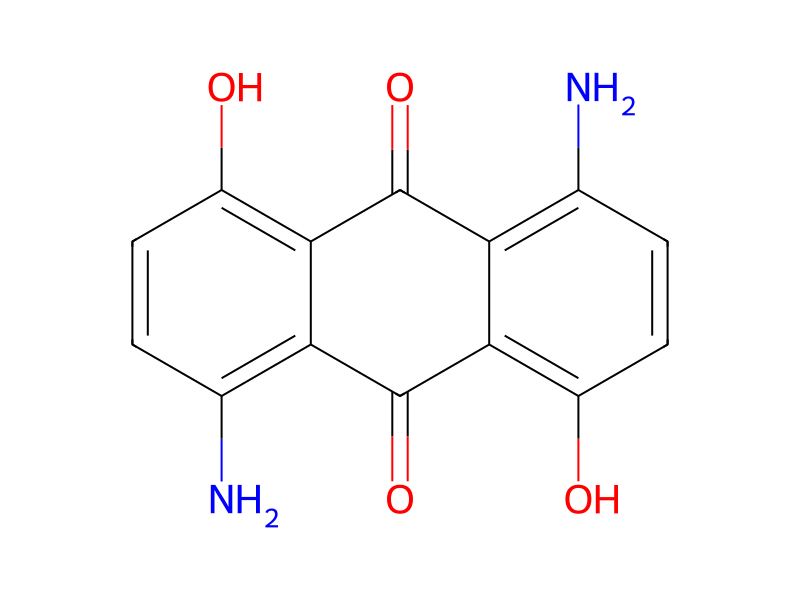
Sodium Hydroxide → 1,5-Diamino-4,8-dihydroxyanthraquinone
HRID 2071314
반응식

[N+:1]([C:4]1[C:17]2[C:16](=[O:18])[C:15]3[C:10](=[C:11]([N+:20]([O-])=O)[CH:12]=[CH:13][C:14]=3[OH:19])[C:9](=[O:23])[C:8]=2[C:7]([OH:24])=[CH:6][CH:5]=1)([O-])=O.[OH-].[Na+].[H][H]>[C].[Pd]>[NH2:1][C:4]1[C:17]2[C:16](=[O:18])[C:15]3[C:10](=[C:11]([NH2:20])[CH:12]=[CH:13][C:14]=3[OH:19])[C:9](=[O:23])[C:8]=2[C:7]([OH:24])=[CH:6][CH:5]=1참가 물질
5




실험 절차
A 500 ml. electromagnetically stirred glass reactor was charged with 5.0 g (0.0151 mole) of 1,5-dinitro-4,8-dihydroxyanthraquinone, 100 g of a 4% aqueous solution of sodium hydroxide and 0.25 g of 5% palladium-carbon. The inside of the reactor was purged with hydrogen, and the 1,5-dinitro-4,8-dihydroxyanthraquinone was hydrogenated at 50° C. with stirring. In 5 hours, 0.0906 mole of hydrogen was absorbed, whereupon the reaction was stopped. The reaction mixture was filtered to separate the catalyst. The filtrate was oxidized with air with stirring at 20° to 30° C. for 2 hours, and then neutralized with 20% sulfuric acid to a pH of 2-3. The crystals precipitated were filtered, washed with water, and dried to afford 4.0 g of 1,5-diamino-4,8-dihydroxyanthraquinone in a yield of 97.8%.