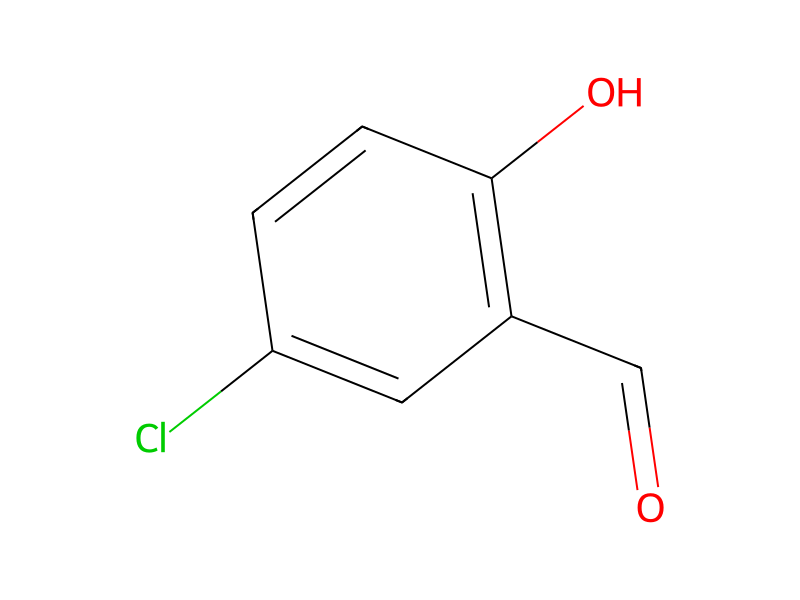
Some product precipitates and is recovered by filtration. The remainder is recovered by diluting the filtrate with water and isolating the precipitate. Combining the solids and drying gives 3-chloro-5-bromo-2-hydroxybenzaldehyde. 3-iodo-5-chlorosalicylaldehyde was prepared by reacting 5-chlorosalicylaldehyde with N-iodosuccinimide in DMF and subjecting the reaction mixture to conventional work-up conditions. 3-iodo-5-bromosalicylaldehyde can be prepared by reacting 5-bromosalicylaldehyde in acetonitrile with potassium iodide and chloramine T. Conventional work-up gives a material that when treated with hexanes gives the desired 3-iodo-5-chlorosalicylaldehyde.