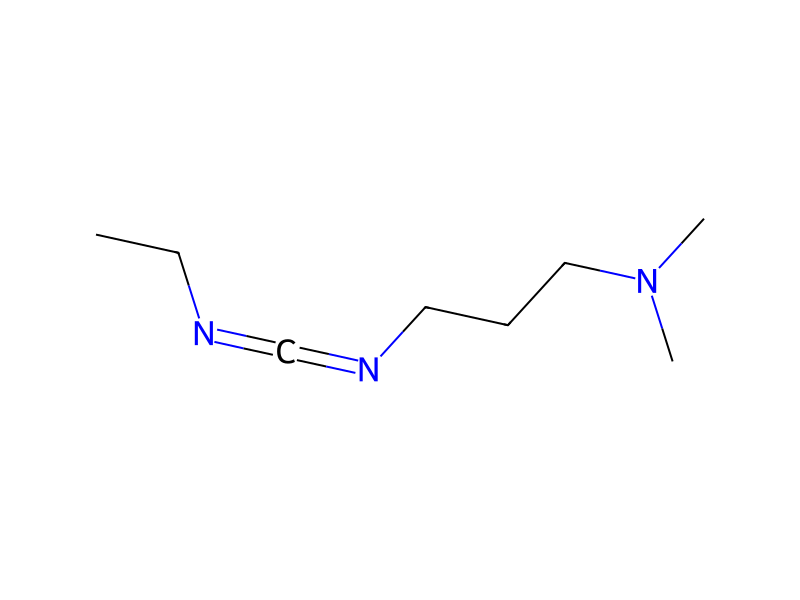
1-Ethyl-3-(3'-dimethylaminopropyl)carbodiimide → (E)-6-(3-(3-((4-Bromothiophen-2-yl)methoxy)azetidin-1-yl)-3-oxoprop-1-enyl)-3,4-dihydro-1,8-naphthyridin-2(1H)-one
HRID 2172103
반응식

Cl.[Br:2][C:3]1[CH:4]=[C:5]([CH2:8][O:9][CH:10]2[CH2:13][NH:12][CH2:11]2)[S:6][CH:7]=1.CCN=C=NCCCN(C)C.C1C=CC2N(O)N=NC=2C=1.C(N(C(C)C)CC)(C)C.Cl.[O:45]=[C:46]1[NH:55][C:54]2[N:53]=[CH:52][C:51](/[CH:56]=[CH:57]/[C:58](O)=[O:59])=[CH:50][C:49]=2[CH2:48][CH2:47]1>CN(C)C=O.O.C(OCC)(=O)C>[Br:2][C:3]1[CH:4]=[C:5]([CH2:8][O:9][CH:10]2[CH2:11][N:12]([C:58](=[O:59])/[CH:57]=[CH:56]/[C:51]3[CH:50]=[C:49]4[C:54](=[N:53][CH:52]=3)[NH:55][C:46](=[O:45])[CH2:47][CH2:48]4)[CH2:13]2)[S:6][CH:7]=1