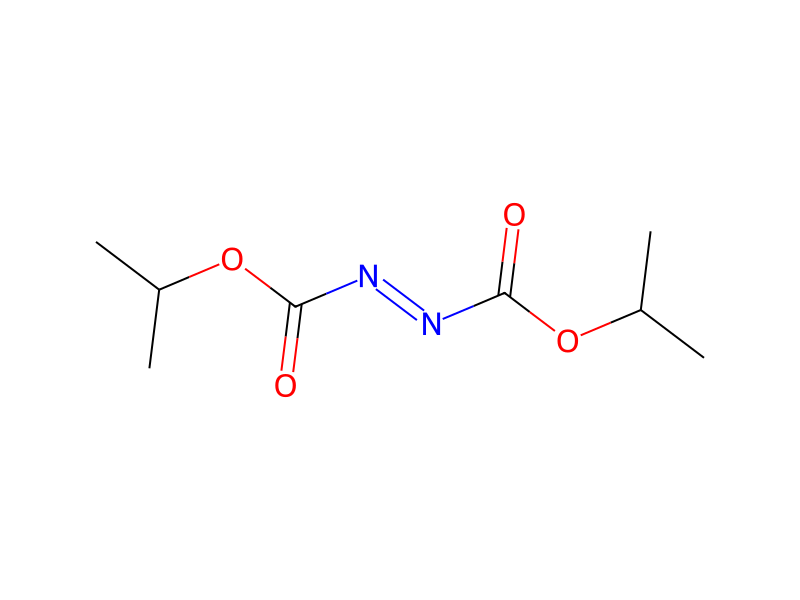
C1(P(C2C=CC=CC=2)C2C=CC=CC=2)C=CC=CC=1.N(C(OC(C)C)=O)=NC(OC(C)C)=O.O[CH2:35][CH:36]1[CH2:42][C:39]2([CH2:41][CH2:40]2)[CH2:38][CH:37]1[C:43]([O:45][CH2:46][CH3:47])=[O:44].[F:48][C:49]1[CH:54]=[CH:53][C:52]([SH:55])=[CH:51][CH:50]=1>CN(C)C=O>[F:48][C:49]1[CH:54]=[CH:53][C:52]([S:55][CH2:35][CH:36]2[CH2:42][C:39]3([CH2:41][CH2:40]3)[CH2:38][CH:37]2[C:43]([O:45][CH2:46][CH3:47])=[O:44])=[CH:51][CH:50]=1A solution of triphenylphosphine (240 mg, 910 μmol) in dimethylformamide (1.1 mL) was cooled to 0° C. Diisopropyl azodicarboxylate (0.16 mL, 0.81 mmol) was added and the reaction mixture was stirred for 5 min. Ethyl(5R/S,6R/S)-6-(hydroxymethyl)spiro[2.4]heptane-5-carboxylate (100 mg, 0.54 mmol) and 4-fluorothiophenol (86 μL, 0.81 mmol) in dimethylformamide (1.7 mL) were added. After stirring the reaction mixture for 19 h, it was partitioned between ethyl acetate (30 mL) and 1:1 water:saturated aqueous sodium chloride (30 mL). The product was extracted into ethyl acetate and the combined organics were washed with saturated aqueous sodium chloride solution, dried over anhydrous sodium sulfate and concentrated using a rotary evaporator. Chromatography of the residue on silica gel eluting with 5:95 ethyl acetate:hexanes provided ethyl(5R/S,6R/S)-6-{[(4-fluorophenyl)sulfanyl]methyl}-spiro[2.4]heptane-5-carboxylate as a colorless oil.