Chloral Hydrate → 1-[2,4-Bis(trichloromethyl)-2H,4H-1,3-benzodioxin-6-yl]propan-1-one
반응식

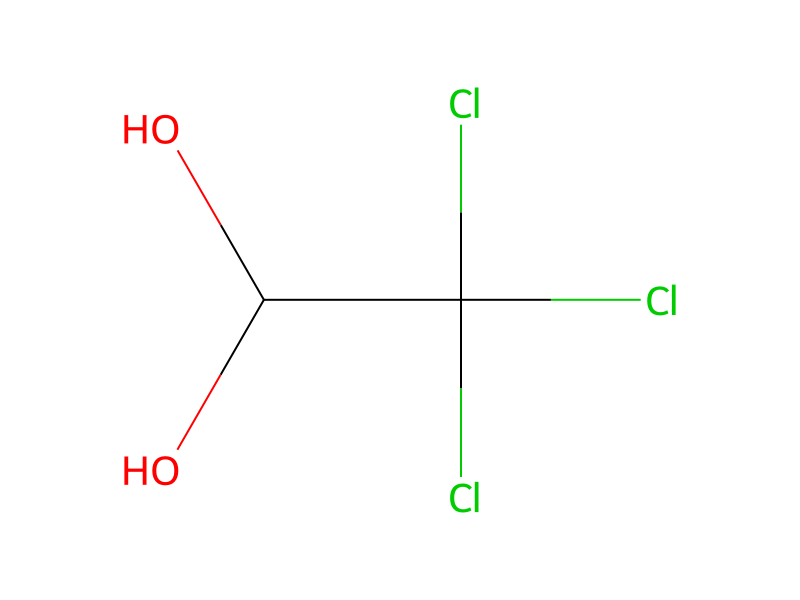
[Cl:1][C:2]([Cl:7])([Cl:6])[CH:3]([OH:5])[OH:4].O[C:9]1[CH:14]=[CH:13][C:12]([C:15](=[O:18])[CH2:16][CH3:17])=[CH:11][CH:10]=1>S(=O)(=O)(O)O>[C:15]([C:12]1[CH:11]=[CH:10][C:9]2[O:5][CH:3]([C:2]([Cl:7])([Cl:6])[Cl:1])[O:4][CH:3]([C:2]([Cl:7])([Cl:6])[Cl:1])[C:14]=2[CH:13]=1)(=[O:18])[CH2:16][CH3:17]참가 물질
4



실험 절차
Chloral hydrate (36.4 g.) was added in portions to a stirred solution of p-hydroxypropiophenone (15 g.) in concentrated sulphuric acid (100 ml.). After the addition was completed, the mixture was stirred at room temperature for 3 hours and then kept for 5 days. The reaction mixture was poured onto ice, and the resulting solid product was filtered off, dissolved in diethyl ether (200 ml.) and filtered to remove any metachloral and unreacted starting material. The filtrate was dried, and evaporated to dryness under reduced pressure. Trituration of the residue with petroleum ether (b.p. 60°-80° C.) gave a solid product, which was crystallised from aqueous ethanol to give 6-propionyl-2,4-bis(trichloromethyl)benzo[1,3]dioxin, m.p. 96°-97° C.