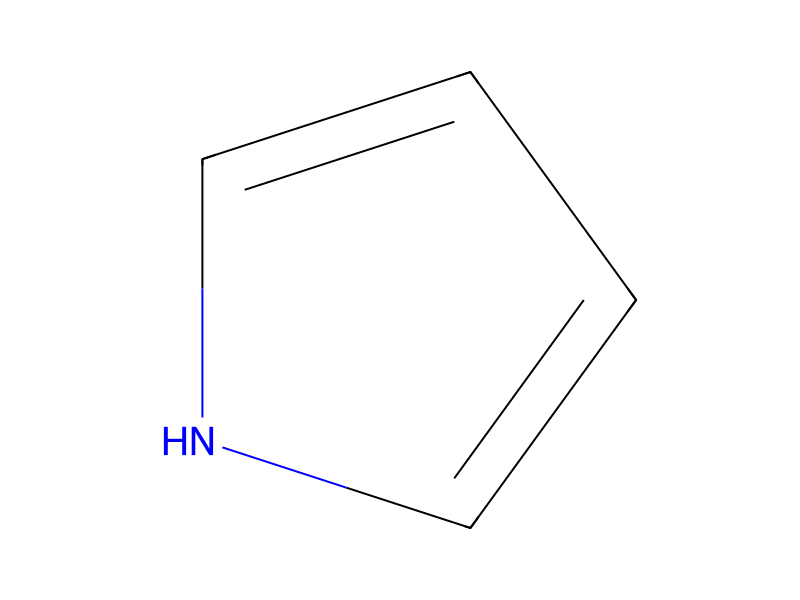
Pyrrole → 2-Phthalidyl-pyrole
반응식

[C:1]([OH:11])(=[O:10])[C:2]1[C:3](=[CH:6][CH:7]=[CH:8][CH:9]=1)[CH:4]=O.[NH:12]1[CH:16]=[CH:15][CH:14]=[CH:13]1.C[C:18]1[NH:19][C:20](C)=[CH:21][CH:22]=1>C1C=CC=CC=1>[C:1]1([C:2]2[C:3](=[CH:6][CH:7]=[CH:8][CH:9]=2)[CH:4]([C:13]2[NH:12][CH:16]=[CH:15][CH:14]=2)[O:11]1)=[O:10].[C:1]1([C:2]2[C:3](=[CH:6][CH:7]=[CH:8][CH:9]=2)[CH:4]([C:22]2[CH:21]=[CH:20][NH:19][CH:18]=2)[O:11]1)=[O:10]참가 물질


실험 절차
Rees et al. in further studies, ibid., pp. 687-91 (1965), reported that the condensation of phthalaldehydic acid could be extended to pyrroles and found that phthalaldehydic acid reacted with pyrrole and 2,5-dimethyl pyrrole in boiling benzene in the absence of an external catalyst to give high yields of 2-phthalidyl-pyrrole and 3-phthalidylpyrrole, respectively. In these reactions, it was observed that pyrrole tended to substitute in the 2-position when possible to yield the 2-phthalidyl derivative. In a further extension of the reactions, the authors found that naphthalaldehydic acid, though less reactive than phthalaldehydic acid, behaved in a similar manner and could be condensed with indole under fusion conditions to yield 3-naphthalidylindole.
후처리
- customto give high
출처 및 근거
- ORD 기록
- ord-e8bf046833364028b958fc8c78f15bd1
- 출처 데이터셋
- uspto-grants-1976_03
- 특허 번호
- US03941807
반응 노트
불러오는 중…