반응식
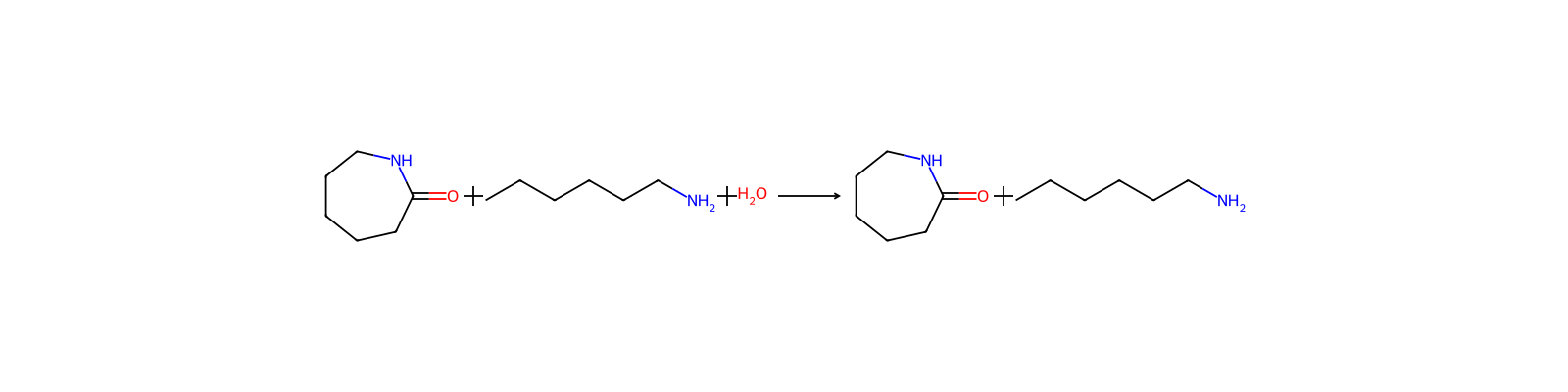
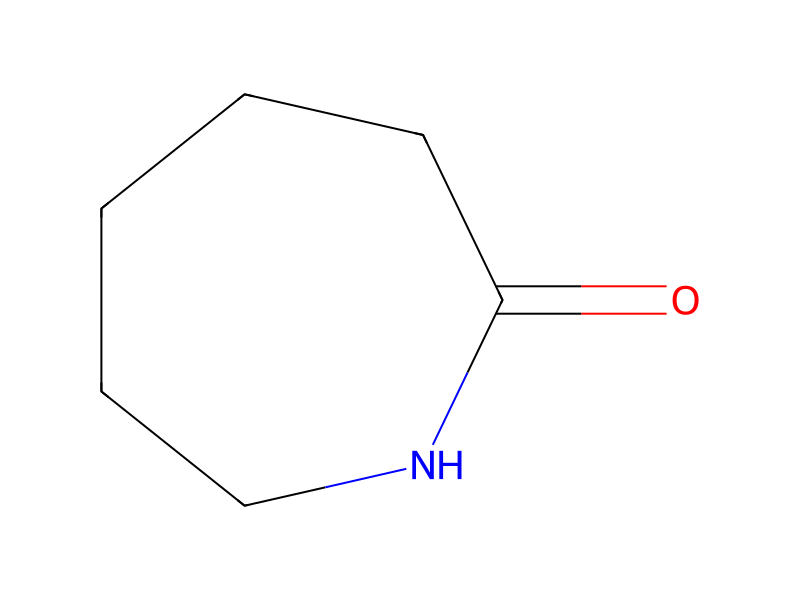
[C:1]1(=[O:8])[NH:7][CH2:6][CH2:5][CH2:4][CH2:3][CH2:2]1.[CH2:9]([NH2:15])[CH2:10][CH2:11][CH2:12][CH2:13][CH3:14].O>>[C:1]1(=[O:8])[NH:7][CH2:6][CH2:5][CH2:4][CH2:3][CH2:2]1.[CH2:9]([NH2:15])[CH2:10][CH2:11][CH2:12][CH2:13][CH3:14]참가 물질



반응 조건
- 온도
- 250 °C
실험 절차
A 200-ml. pressure reactor was charged with 50 g. (0.442 mole) of ε-caprolactam (CL), 10 g. (0.099 mole) of n-hexylamine (HA) and 0.2 g. (0.011 mole) of water. The reactor was cooled in a dry ice-acetone bath, evacuatively purged twice with nitrogen, evacuated, and heated at 250° C. for 16 hours with the contents under autogenous pressure. The cooled product was a soft white solid. A 45-g. portion was extracted by centrifugation first with about 900 ml. of 1:1 acetone:water and secondly with acetone. The air-dried residue weighed 25.5 g., and could be readily crushed to a fine powder. Analysis showed 865 equivalents of amino end groups per 106 g., corresponding to a degree of polymerization (DP) of about 9. Differential scanning calorimetry (DSC) showed a major melting endotherm at 196°-198° C.
후처리
- additionpressure reactor was charged with 50 g
- temperatureThe reactor was cooled in a dry ice-acetone bath
- customevacuatively purged twice with nitrogen
- customevacuated
- extractionportion was extracted by centrifugation first with about 900 ml
- custom, and could be readily crushed to a fine powder
- custom, corresponding to a degree of polymerization (DP) of about 9
- customat 196°-198° C.
출처 및 근거
- ORD 기록
- ord-25e331e0a5a340eb8acf8cef3c0a59b8
- 출처 데이터셋
- uspto-grants-1980_09
- 특허 번호
- US04225476
연결된 노트
불러오는 중…