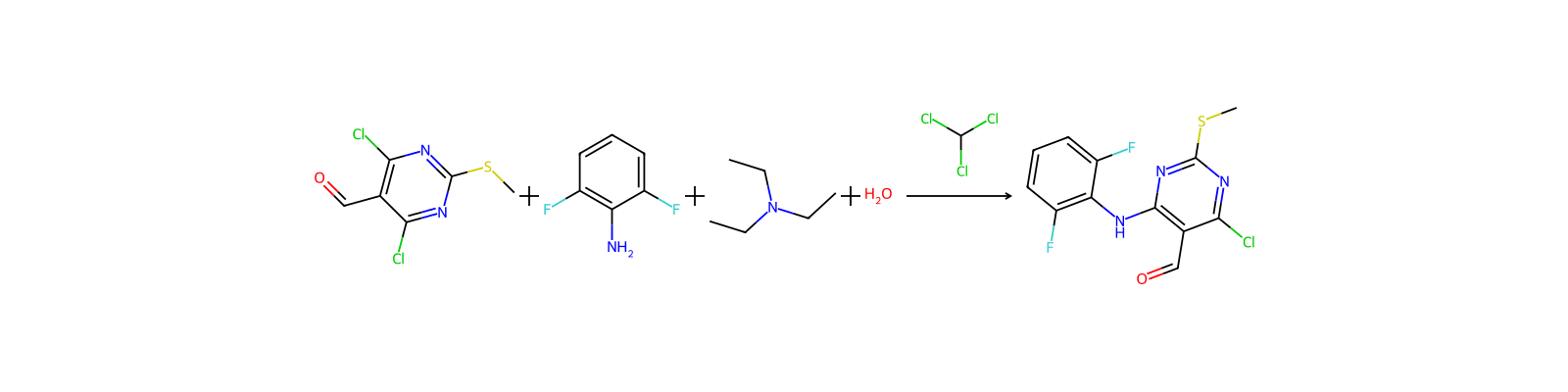
To a solution of 4,6-dichloro-2-methylsulfanyl-pyrimidine-5-carbaldehyde (11.1 grams(hereinafter “g”), 50 millimoles (hereinafter “mmol”)) in CHCl3 (100 milliliters (hereinafter “mL”)) was added 2,6-difluoroaniline (8.07 mL, 75 mmol, 1.5 equivalents (hereinafter “eq”)) followed by Et3N (10.43 mL, 75 mmol, 1.5 eq). The reaction mixture turned yellow and was heated to reflux for 24 h, H2O (50 mL) was added and the layers were separated. The organic layer was evaporated and the crude product was recrystallized from 200 mL of a methanol: H2O mixture (2:1) to give 12.03 g (76%) of pure 4-chloro-6-(2,6-difluoro-phenylamino)-2-methylsulfanyl-pyrimidine-5-carbaldehyde. 1H-NMR: δ 2.21 (s, 3H), 6.91 (m, 2H), 7.24 (m, 1H), 10.29 (s, 1H), 10.35 (br s, 1H). LC MS (m/e)=316 (MH+).