반응식
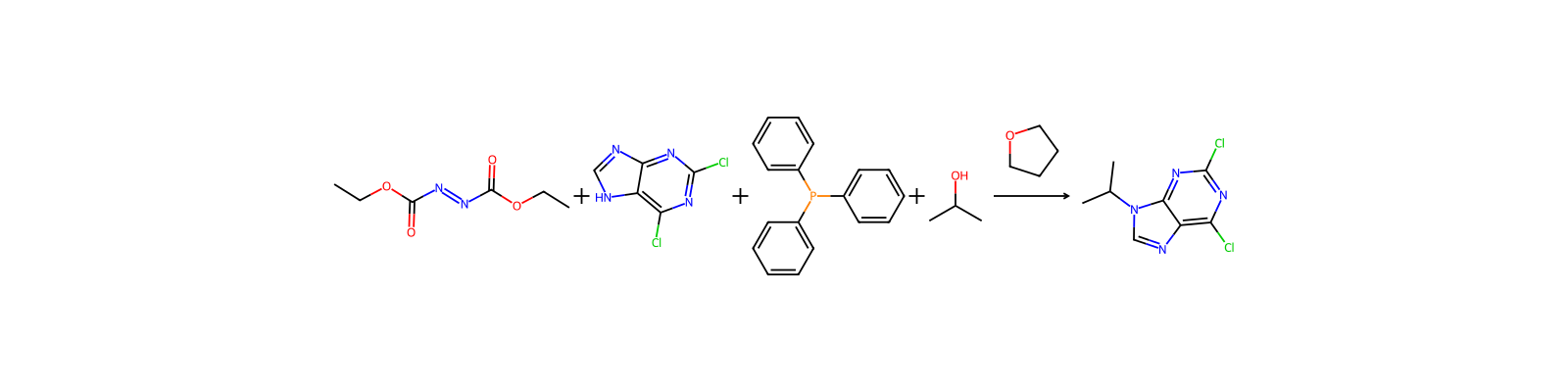
CCOC(/N=N/C(OCC)=O)=O.[Cl:13][C:14]1[N:22]=[C:21]2[C:17]([NH:18][CH:19]=[N:20]2)=[C:16]([Cl:23])[N:15]=1.[C:24]1(P(C2C=CC=CC=2)C2C=CC=CC=2)[CH:29]=CC=C[CH:25]=1.C(O)(C)C>C1COCC1>[Cl:13][C:14]1[N:22]=[C:21]2[C:17]([N:18]=[CH:19][N:20]2[CH:24]([CH3:29])[CH3:25])=[C:16]([Cl:23])[N:15]=1참가 물질
6






실험 절차
Add DEAD (4.7 g, 27.09 mmol) slowly to a solution of 2,6-dichloropurine (1, 5 g, 26.5 mmol), triphenylphosphine (1 1.75 g, 44.5 mmol) and isopropyl alcohol (2b, 10 ml) in THF (100 ml), and stir at room temperature for 24 hours. Concentrate the reaction mixture, dissolve the residue in DCM (20 ml) and filter to remove the unwanted solids. Load the filtrate onto a 90 gram silica gel column (Biotage), and elute with DCM/acetone (95:5). Concentrate the desired fractions to give 3.0 grams of 2,6-dichloro-9-isopropyl-9H-purine (3b). 1H-NMR (CDCl3): δ 8.2(s, 1H), 4.95 (pentet, 1H), 1.63 (d, 6H)
후처리
- concentrationConcentrate the reaction mixture
- dissolutiondissolve the residue in DCM (20 ml)
- filtrationfilter
- customto remove the unwanted solids
- washLoad the filtrate onto a 90 gram silica gel column (Biotage), and elute with DCM/acetone (95:5)
- concentrationConcentrate the desired fractions
출처 및 근거
- ORD 기록
- ord-111d6fea9fff42cfb2b4ea6057a5ce78
- 출처 데이터셋
- uspto-grants-2008_09
- 특허 번호
- US07429595B2
연결된 노트
불러오는 중…