Propylamine → HCID 86662067, 화합물
HRID 336431
반응식

[Cl:1][C:2]1[CH:11]=[C:10]([Cl:12])[C:5]([C:6]([O:8]C)=O)=[C:4]([N+:13]([O-:15])=[O:14])[C:3]=1[O:16][CH3:17].[CH2:18]([NH2:21])[CH2:19][CH3:20]>S(Cl)(Cl)=O>[Cl:1][C:2]1[CH:11]=[C:10]([Cl:12])[C:5]([C:6]([NH:21][CH2:18][CH2:19][CH3:20])=[O:8])=[C:4]([N+:13]([O-:15])=[O:14])[C:3]=1[O:16][CH3:17]참가 물질
4
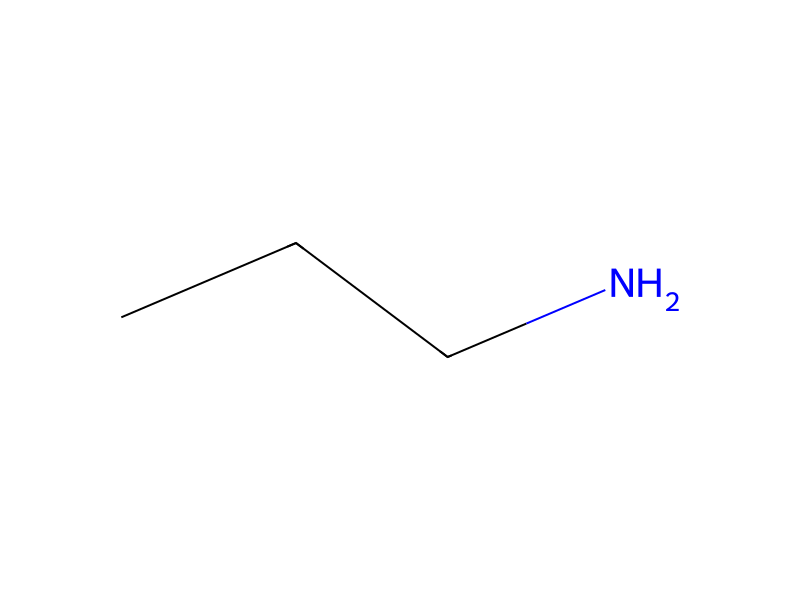



반응 조건
- 온도
- 0 °C
실험 절차
The acid 2-2 (1.41 g, 5.3 mmol) was heated to reflux in thionyl chloride (20 mL) for 2 h. After cooling, the volatiles were removed in vacuo and the residue was azeotroped with toluene. The resulting acid chloride was dried at high vacuum and then dissolved in anhydrous CH2Cl2 (50 mL), cooled to 0° C. then treated with propylamine (2.45 mL, 29.9 mmol). The reaction was warmed to room temperature for 2 h. The solvent was removed in vacuo and the residue was taken up in EtOAc and brine. The aqueous layer was extracted three times into EtOAc and the combined organic layers were washed with H2O, dried over Na2SO4, filtered and concentrated to provide the amide in which R is propyl 4-5 as a light orange solid. (1.5 g, 92% yield). 1H NMR (400 MHz, d6-DMSO) δ 0.91 (t, J=7.0 Hz, 3H), 1.40 (q, J=7.0 Hz, 2H), 3.07 (q, J=7.0 Hz, 2H), 3.84 (s, 3H), 8.13 (s, 1H), 8.84 (br s, 1H).