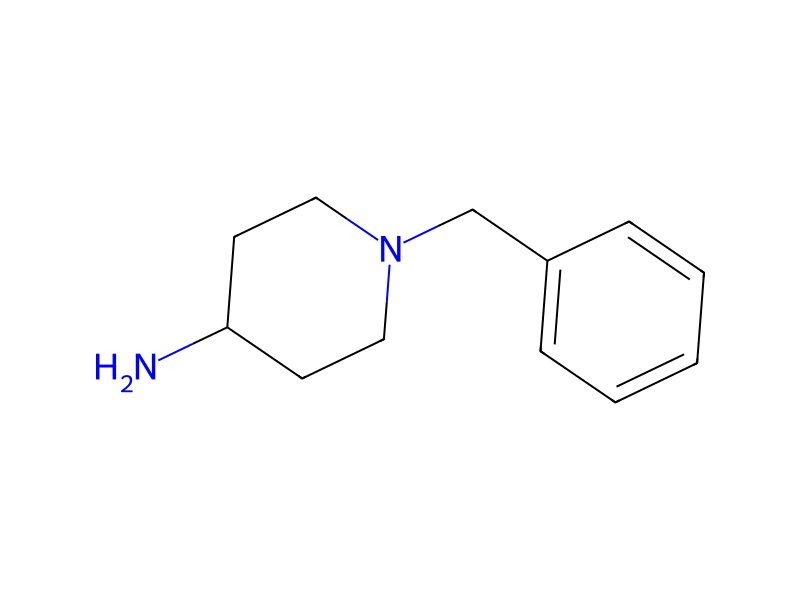
[OH:1][C:2]1[CH:3]=[C:4]2[C:8](=[CH:9][CH:10]=1)[NH:7][C:6]([C:11]([OH:13])=O)=[CH:5]2.ON1C2C=CC=CC=2N=N1.Cl.CN(C)CCCN=C=NCC.[CH2:36]([N:43]1[CH2:48][CH2:47][CH:46]([NH2:49])[CH2:45][CH2:44]1)[C:37]1[CH:42]=[CH:41][CH:40]=[CH:39][CH:38]=1>CN(C)C=O.C(N(CC)CC)C>[CH2:36]([N:43]1[CH2:48][CH2:47][CH:46]([NH:49][C:11]([C:6]2[NH:7][C:8]3[C:4]([CH:5]=2)=[CH:3][C:2]([OH:1])=[CH:10][CH:9]=3)=[O:13])[CH2:45][CH2:44]1)[C:37]1[CH:38]=[CH:39][CH:40]=[CH:41][CH:42]=1To a stirred mixture of 5-hydroxy-1H-indole-2-carboxylic acid (1.85 g, 10.43 mmol) in anhydrous dimethylformamide (15 mL) was added triethylamine (1.73 mL), 1-hydroxybenzotriazole (1.64 g), 1-(3-dimethylaminopropyl)-3-ethylcarbodiimide hydrochloride (2.39 g) and 1-benzylpiperidin-4-ylamine (2.39 g, 12.54 mmol). The reaction mixture was stirred at room temperature over-night and then solvents were removed under reduced pressure, poured into water, filter the solid and washed with water. The solid was purified by silica gel column chromatography, eluted with CH2Cl2:MeOH (93:7) to afford 0.87 g (24%) of N-(1-benzylpiperidin-4-yl)-5-hydroxy-1H-indole-2-carboxamide as a white solid. 1H NMR (DMSO-d6, 300 MHz): δ 11.17 (s, 1H), 8.72 (s, 1H), 8.07 (d, J=7.8 Hz, 1H), 7.7.29 (m, 6H), 6.91 (s, 1H), 6.82 (s, 1H), 6.68 (m, 1H), 3.75 (br s, 1H), 3.46 (s, 2H), 2.81 (d, J=11.4 Hz, 2H), 2.02 (t, J=10.8 Hz, 2H), 1.77 (m, 2H), 1.56 (m, 2H); LCMS (m/z): 350 (MH+).