Triphenylphosphine → 2,6,6-Trimethyl-2-cyclohexen-1-one
반응식

[CH3:1][C:2]12[O:8][CH:7]1[CH2:6][CH2:5][C:4]([CH3:10])([CH3:9])[C:3]2=[O:11].C1(P(C2C=CC=CC=2)C2C=CC=CC=2)C=CC=CC=1.C1(P(C2C=CC=CC=2)CCP(C2C=CC=CC=2)C2C=CC=CC=2)C=CC=CC=1>>[OH:8][C:7]1[CH2:6][CH2:5][C:4]([CH3:9])([CH3:10])[C:3](=[O:11])[C:2]=1[CH3:1].[CH3:1][C:2]1[C:3](=[O:11])[C:4]([CH3:10])([CH3:9])[CH2:5][CH2:6][CH:7]=1참가 물질
5



실험 절차
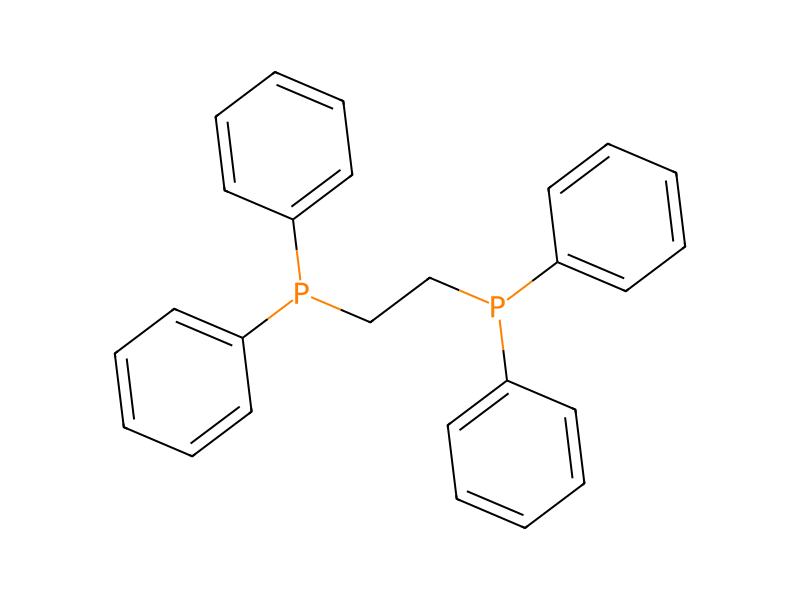
15.4 g of 1,3,3-trimethyl-7-oxabicyclo-[4.1.0]heptan-2-one, 1.8 g of triphenylphosphine and 2.76 g of 1,2-bis-(diphenylphosphino)-ethane were placed under argon gasification in a round flask equipped with a thermometer and a reflux condenser and the mixture was treated with 2.0 g of bis-(dibenzylidene acetone)palladium(O). The reaction vessel was then immersed in an oil-bath preheated to 150° C. and the reaction mixture was stirred at this temperature with a magnetic stirrer for 1 hour under continued argon gasification. A gas-chromatographical analysis of the mixture obtained without an internal standard gave peaks for 3-hydroxy-2,6,6-trimethyl-2-cyclohexen-1-one (81.9 area %) and 2,6,6-trimethyl-2-cyclohexen-1-one (18 area %). For the working-up, the reaction mixture, cooled to room temperature, was taken up in 20 ml of ethyl acetate and filtered over silica gel in a sintered glass suction filter. The content of the suction filter was rinsed three times with 150 ml of ethyl acetate each time. The filtrate was evaporated to constant weight in a rotary evaporator under a water-jet vacuum at a bath temperature of 40° C. The residue (21.5 g of a yellowish oil) was dissolved in 100 ml of diethyl ether and the solution was added to a separating funnel S1. Two further separating funnels S2 and S3 were each charged with 100 ml of diethyl ether. Then, three 150 ml portions of 3N sodium hydroxide solution were passed in succession and with good intermixing through the three extraction vessels S1 -S3. The ether phases were discarded. The combined alkaline extracts were acidified cautiously (pH about 1) with about 300 ml of concentrated hydrochloric acid while cooling with ice and then saturated with 500 g of sodium chloride while stirring. Three separating funnels S4 -S6 were each charged with 200 ml of ethyl acetate. Thereafter, the aqueous product solution and subsequently three 150 ml portions of saturated sodium chloride solution were passed in succession and with good intermixing through the three extraction vessels S4 -S6. The combined organic phases were dried over sodium sulphate. The drying agent was filtered off under suction and rinsed on the suction filter twice with 100 ml of ethyl acetate each time. The filtrate was evaporated in a rotary evaporator under a water-jet vacuum at a bath temperature of 40° C. and the residue was dried in a high vacuum. There were obtained 10.1 g (65.6%) of 3-hydroxy-2,6,6-trimethyl-2-cyclohexen-1-one in the form of colourless crystals with a purity of 99.6%: m.p. 112°-114° C. after recrystallization from diisopropyl ether.