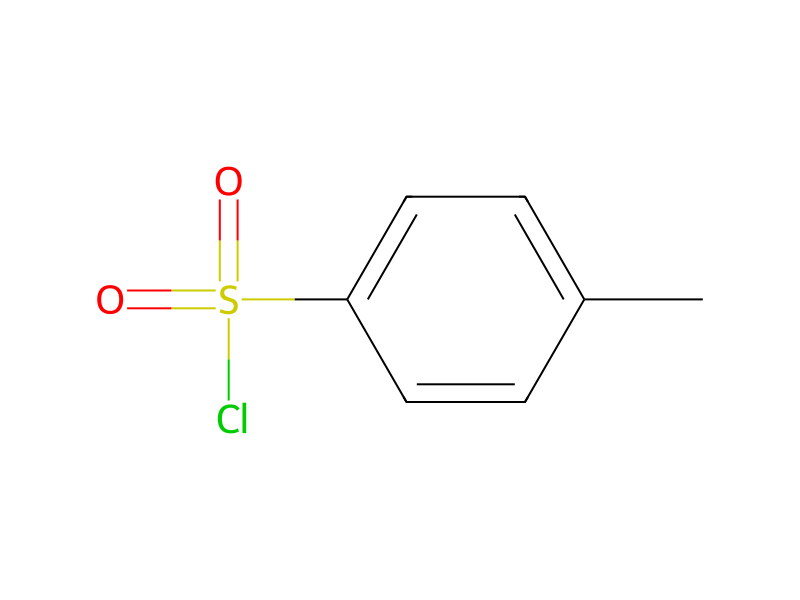
To 3-(2-amino-4-chloro-phenyl)-acrylic acid ethyl ester (18.0g, 79.8 mmol) in dichloromethane (144 ml) was added pyridine (9.04 ml, 112 mmol) and p-toluenesulfonyl chloride (16.0g, 83.9 mmol). The reaction was stirred at room temperature for 18 hours and poured into 1N hydrochloric acid (150 ml). The layers were separated and the organic layer was dried over magnesium sulfate, filtered, and concentrated. The resulting solid was slurried in hexanes and filtered to afford 3-[4-chloro-2-(toluene-4-sulfonylamino)-phenyl]-acrylic acid ethyl ester (28.3g, 93%). mp=124-127° C. 1H NMR (300 MHz, CDCl3) d 1.35 (t, 3, J=7.2), 2.40 (s, 3), 4.27 (q, 2, J=7.2), 6.12 (dd, 1, J=15.9, 0.9), 7.20-7.39 (m, 4), 7.39 (d, 1, J=8.6), 7.48-7.53 (m, 2), 7.62 (d, 2, J=8.3). 13C NMR (75 MHz, CDCl3) d 15.50, 22.79, 62.24, 122.48, 127.98, 128.49, 129.34, 129.50, 131.05, 136.82, 137.00, 137.73, 138.93, 145.55, 167.59. IR 3214, 1694, 1631, 1318, 1167 cm−1. Analysis calculated for C18H18ClNO4S: C, 56.91; H, 4.78; N, 3.69. Found: C, 57.10; H, 5.08; N, 3.70.