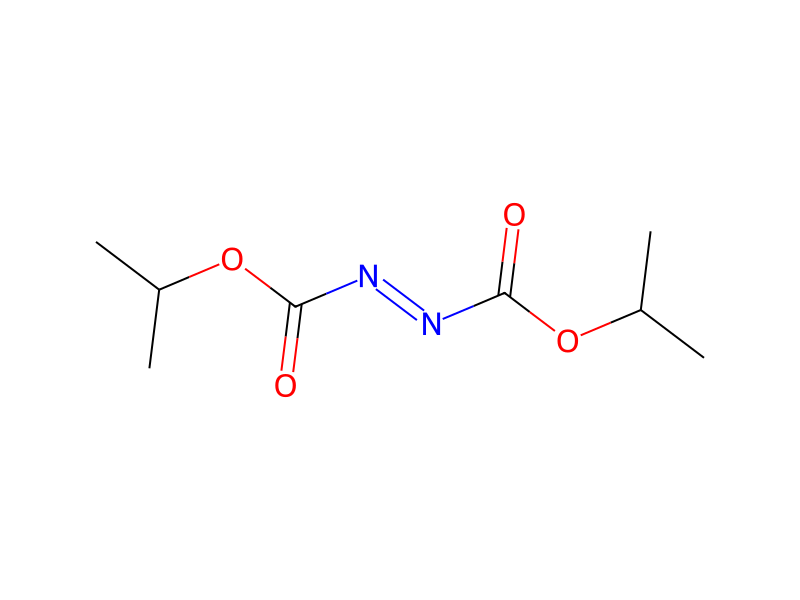
[OH:1][C:2]1[CH:3]=[C:4]([CH2:8][C:9]([O:11][CH3:12])=[O:10])[CH:5]=[CH:6][CH:7]=1.[C:13]([N:20]1[CH2:25][CH2:24][CH:23]([CH2:26][CH2:27][CH2:28]O)[CH2:22][CH2:21]1)([O:15][C:16]([CH3:19])([CH3:18])[CH3:17])=[O:14].C1(P(C2C=CC=CC=2)C2C=CC=CC=2)C=CC=CC=1.N(C(OC(C)C)=O)=NC(OC(C)C)=O>C1COCC1>[C:13]([N:20]1[CH2:21][CH2:22][CH:23]([CH2:26][CH2:27][CH2:28][O:1][C:2]2[CH:3]=[C:4]([CH2:8][C:9]([O:11][CH3:12])=[O:10])[CH:5]=[CH:6][CH:7]=2)[CH2:24][CH2:25]1)([O:15][C:16]([CH3:19])([CH3:18])[CH3:17])=[O:14]To a solution of methyl 3-hydroxyphenylacetate (0.409 g, 2.4 mmol), 3-(N-Boc-piperidin-4-yl)-propan-1-ol (0.50 g, 20.5 mmol) and triphenylphosphine (0.645, 24.6 mmol) in THF, was added diisopropyl azodicarboxylate at 0° C. slowly, then the ice bath was removed and the reaction mixture was stirred at room temperature overnight. The solvent was removed and the residue was dissolved in methylene chloride (2 mL) and loaded on a silica gel column. The product was eluted with 20% ethyl acetate in hexane, to afford methyl 3-(3-(N-Boc-piperidin-4-yl)-propoxy)-phenylacetate (0.5 g, 62%). 1H NMR (CDCl3) δ1.1 (m, 2H), 1.4 (m, 2H), 1.46 (s, 9H), 1.66 (d, 2H), 1.78 (m, 2H), 2.67 (t, 2H), 3.58 (s, 2H), 3.68 (s, 3H), 4.05 (m, 2H), 6.75 (m, 3H), 7.18 (dd, 1H).