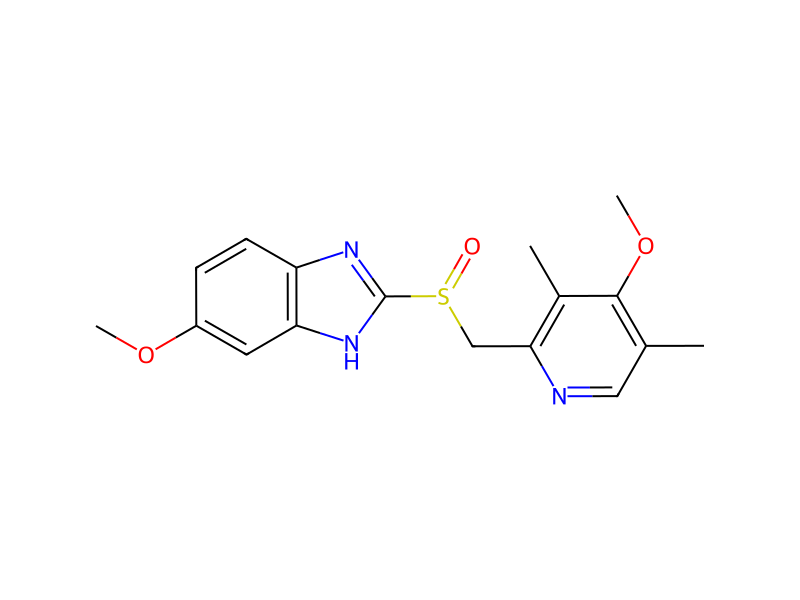
To a solution of 5-methoxy-2-[(4-methoxy-3,5-dimethylpyridin-2-yl)methylthio]-1H-benzimidazole (30 g) in dichloromethane (165 mL) at 0-5° C., under an inert atmosphere, was added meta-chloroperbenzoic acid (0.95 eq) over 10 minutes. The mixture was stirred for 10-15 minutes. To the reaction was added 12% ammonium hydroxide (180 mL). The layers were separated. The organic layer was extracted with 12% ammonium hydroxide (2×180 mL). The combined aqueous layers were washed with toluene (90 mL). To the aqueous layer was added dichloromethane (120 mL) and the mixture was cooled to 0-5° C. The pH was adjusted to pH=8.5-9.5 using 50% aqueous acetic acid. The layers were separated. The aqueous layer was extracted with dichloromethane (2×90 mL). The combined organic layers were washed with brine (30 mL), dried over sodium sulfate, filtered through celite and vacuum distilled to 150 mL to give a solution of 5-methoxy-2-[[(4-methoxy-3,5-dimethylpyridin-2-yl)methyl]sulphinyl]1H-benzimidazole in dichloromethane.