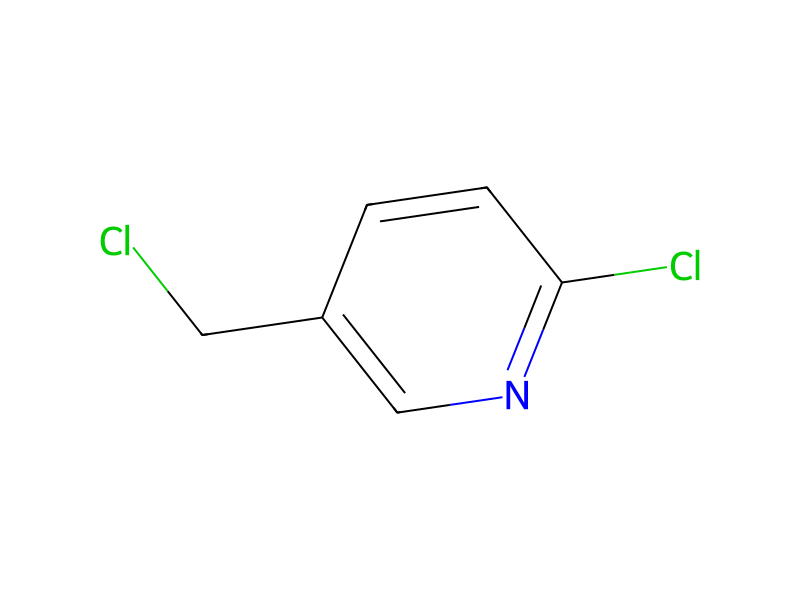
To a suspension of 2-chloro-5-(chloromethyl)pyridine (971 mg, 5.99 mmol) in acetonitrile (50 mL) was added a solution of N-methylpiperazine (1.20 g, 12.0 mmol) in acetonitrile (3 mL) followed by potassium carbonate (0.83 g, 5.99 mmol). The obtained yellow solution was heated at reflux for 40 min. The mixture was allowed to cool for 10 min and the solvent was removed in vacuo. The residue was partitioned between water, NaCl (s), and ethyl acetate. The aqueous layer was extracted with another portion of ethyl acetate. The combined organic layers were dried (Na2SO4) and the solvent was removed in vacuo affording 1.0 g (74% yield) of the title compound as a yellow oil: 1H NMR (CDCl3, 400 MHz) δ 8.31 (d, J=2 Hz, 1 H), 7.65 (dd, J=8, 2 Hz, 1 H), 7.29 (d, J=8 Hz, 1 H), 3.49 (s, 2 H), 2.46 (br s, 8 H), 2.28 (s, 3 H); 13C NMR (CDCl3, 100 MHz) δ 150.2, 150.1, 139.5, 132.8, 124.0, 59.2, 55.0, 53.0,46.0; MS (ESP) m/z 226 (M++1).