반응식
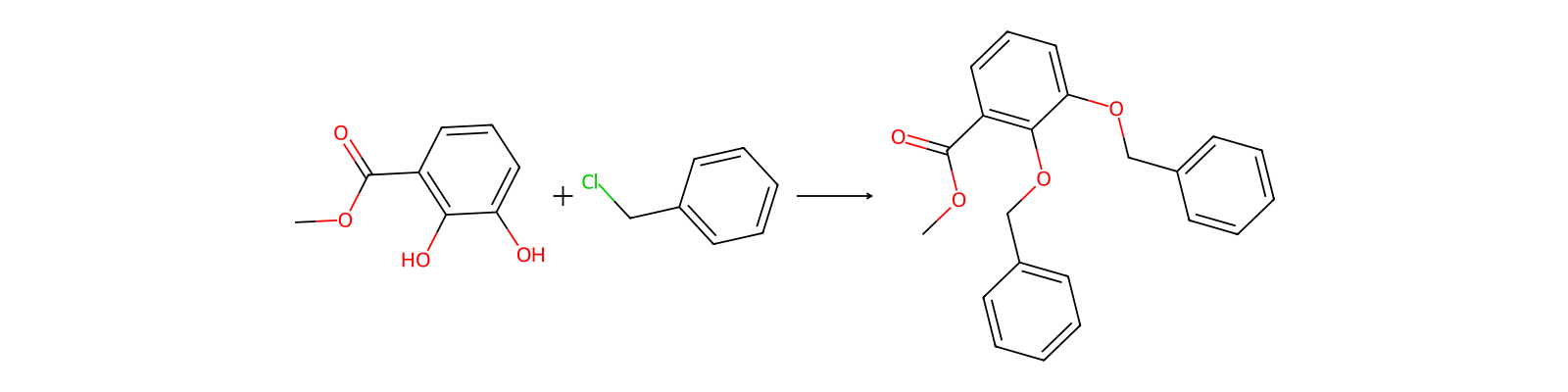
[CH3:1][O:2][C:3](=[O:12])[C:4]1[CH:9]=[CH:8][CH:7]=[C:6]([OH:10])[C:5]=1[OH:11].[CH2:13](Cl)[C:14]1[CH:19]=[CH:18][CH:17]=[CH:16][CH:15]=1>>[CH3:1][O:2][C:3](=[O:12])[C:4]1[CH:9]=[CH:8][CH:7]=[C:6]([O:10][CH2:13][C:14]2[CH:19]=[CH:18][CH:17]=[CH:16][CH:15]=2)[C:5]=1[O:11][CH2:3][C:4]1[CH:9]=[CH:8][CH:7]=[CH:6][CH:5]=1참가 물질
3


실험 절차
In one embodiment, the compounds can be prepared as shown in Scheme II. A dihydroxy benzoic acid methyl ester is reacted with benzyl chloride, to produce a Bis-benzyloxy benzoic acid methyl ester (1). The Bis-benzyloxy benzoic acid methyl ester can then be heated with LiOH to give a Bis-benzyloxy benzoic acid (2). The Bis-benzyloxy benzoic acid (2) is then reacted with an aminophenyl to produce a phenyl-benzamide (3). The phenyl-benzamide (3) is then reacted with hydrazine to give a triazol (4). The hydroxy groups can then be unprotected in the presence of palladium on charcoal to give the final product.
후처리
- customIn one embodiment, the compounds can be prepared
출처 및 근거
- ORD 기록
- ord-ebfc6169a3ab4ce89cf4bf4ea3f92fa0
- 출처 데이터셋
- uspto-grants-2014_09
- 특허 번호
- US08835464B2
연결된 노트
불러오는 중…