홈MCP워크벤치Skills
홈워크벤치알림마이페이지
llms.txt · MCP 가이드개인정보처리방침 · 이용약관 · 지원v1.8.0
  1. 홈
  2. /반응

1,2-Dichloroethane → N-[5-chloro-2-(1H-tetraazol-1-yl)benzyl]-1-(2-hydroxy-2-pyridin-2-ylpropanoyl)-L-prolinamide

HRID 857757
노트
인쇄 미리보기

반응식

HRID 857757 반응식
[OH:1][CH:2]([C:6]1[CH:11]=[CH:10][CH:9]=[CH:8][N:7]=1)[C:3]([OH:5])=O.[Na+].[Cl-].[Cl:14][C:15]1[CH:16]=[CH:17][C:18]([N:30]2[CH:34]=[N:33][N:32]=[N:31]2)=[C:19]([CH:29]=1)[CH2:20][NH:21][C:22](=[O:28])[C@@H:23]1[CH2:27][CH2:26][CH2:25][NH:24]1.[CH:35]1C=C2N=NN(O)C2=CC=1.O.C(Cl)CCl.C(N(C(C)C)CC)(C)C>CN(C=O)C>[Cl:14][C:15]1[CH:16]=[CH:17][C:18]([N:30]2[CH:34]=[N:33][N:32]=[N:31]2)=[C:19]([CH:29]=1)[CH2:20][NH:21][C:22](=[O:28])[C@@H:23]1[CH2:27][CH2:26][CH2:25][N:24]1[C:3](=[O:5])[C:2]([OH:1])([C:6]1[CH:11]=[CH:10][CH:9]=[CH:8][N:7]=1)[CH3:35]
참가 물질실험 절차후처리출처 및 근거반응 노트

참가 물질

8

반응물 6

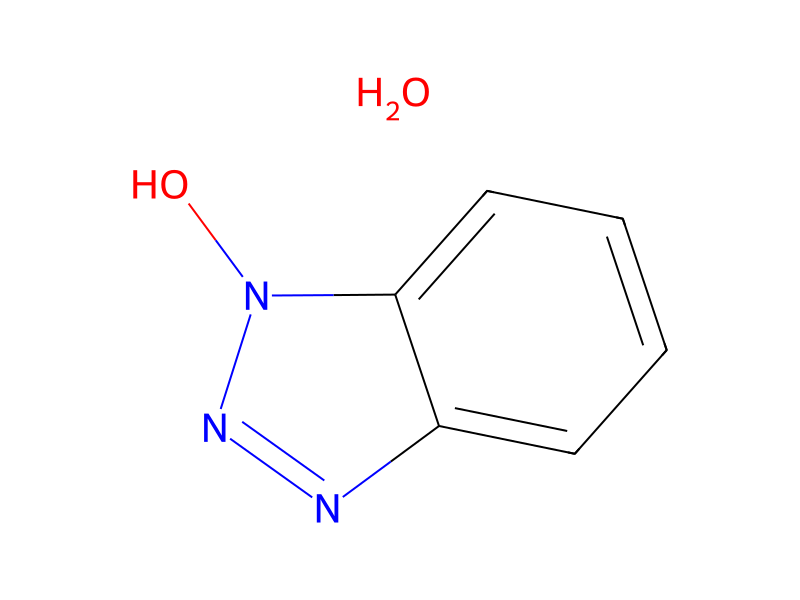
HCID 111,2-DichloroethaneHCID 5234Sodium ChlorideHCID 81531DiisopropylethylamineHCID 4150612-Hydroxy-2-(2-pyridyl)acetic acidHCID 27960291-Hydroxybenzotriazole hydrateHCID 69655818N-[5-chloro-2-(1H-tetraazol-1-yl)benzyl]-L-prolinamide

생성물 1

HCID 58760167
N-[5-chloro-2-(1H-tetraazol-1-yl)benzyl]-1-(2-hydroxy-2-pyridin-2-ylpropanoyl)-L-prolinamide

시약·촉매·용매 1

HCID 6228Dimethylformamide용매

실험 절차

To a solution of 2-hydroxy-2-(2-pyridyl)acetic acid from the previous step (160 mg as a 1:1 mixture with NaCl, 0.71 mmol), N-[5-chloro-2-(1H-tetraazol-1-yl)benzyl]-L-prolinamide (215 mg, 0.71 mmol, HPLC RT=2.25 min, method A), and HOBt hydrate (110 mg, 0.71 mmol) in DMF (5 mL) was added EDC (175 mg, 0.92 mmol). Diisopropylethylamine was then added slowly in portions (˜0.1 mL total) to bring the pH of the solution to 6–7 as measured on wetted E. Merck pH indicator strips. The mixture was stirred at ambient temperature for 18 h, and the solvent was removed under reduced pressure. The residue was partitioned between EtOAc (75 mL) and saturated aqueous NaHCO3 (20 mL). The EtOAc layer was separated, dried over anhydrous MgSO4, and filtered. The filtrate solvent was removed under reduced pressure and the residue was purified by pressurized silica gel column chromatography using a gradient elution of 2%, 3%, 4%, 5%, 6% MeOH in dichloromethane. Product-containing fractions were combined and the solvent was removed under reduced pressure to give two diastereomers of the title compound, both as amorphous solids (first eluting diastereomer: 96 mg; TLC Rf=0.3 (96:4 CH2Cl2:MeOH); HPLC RT=2.32 min, method A; LC-MS m/z=456; second eluting diastereomer: TLC Rf=0.2 (96:4 CH2Cl2:MeOH); HPLC RT=2.33 min, method A; LCMS m/z=456).


후처리

  1. customthe solvent was removed under reduced pressure
  2. customThe residue was partitioned between EtOAc (75 mL) and saturated aqueous NaHCO3 (20 mL)
  3. customThe EtOAc layer was separated
  4. dry with materialdried over anhydrous MgSO4
  5. filtrationfiltered
  6. customThe filtrate solvent was removed under reduced pressure
  7. customthe residue was purified by pressurized silica gel column chromatography
  8. washa gradient elution of 2%, 3%, 4%, 5%, 6% MeOH in dichloromethane
  9. customthe solvent was removed under reduced pressure

출처 및 근거

ORD 기록
ord-d8d43be467254a788cb81fac8b2ca48f
출처 데이터셋
uspto-grants-2006_12
DOI
10.6084/m9.figshare.5104873.v1
특허 번호
US07144899B2

반응 노트

불러오는 중…

이 페이지에서참가 물질실험 절차후처리출처 및 근거반응 노트