반응식

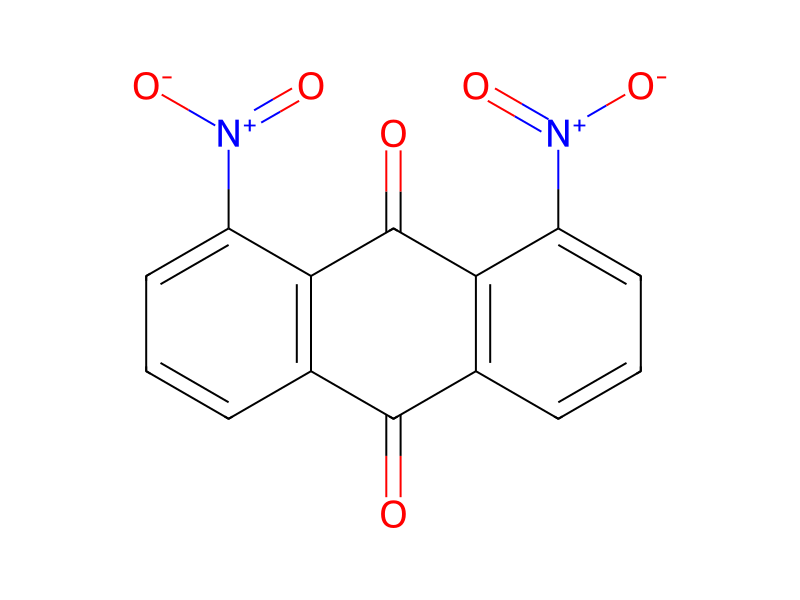
[N+:1]([C:4]1[C:17]2[C:16](=[O:18])[C:15]3[C:10](=[CH:11][CH:12]=[CH:13][CH:14]=3)[C:9](=[O:19])[C:8]=2[CH:7]=[CH:6][CH:5]=1)([O-])=O.[N+](C1C2C(=O)C3C(=C([N+]([O-])=O)C=CC=3)C(=O)C=2C=CC=1)([O-])=O.[N+](C1C2C(=O)C3C(=CC=CC=3[N+]([O-])=O)C(=O)C=2C=CC=1)([O-])=O.[OH-].[Na+]>>[NH2:1][C:4]1[C:17]2[C:16](=[O:18])[C:15]3[C:10](=[CH:11][CH:12]=[CH:13][CH:14]=3)[C:9](=[O:19])[C:8]=2[CH:7]=[CH:6][CH:5]=1참가 물질




실험 절차
A 1-liter electromagnetically stirred cylindrical glass reactor was charged with 5.0 g of crude ;b 1-nitroanthraquinone having a purity of 81% and containing 8% of 1,5-dinitroanthraquinone, 4% of 1,8-dinitroanthraquinone and 7% of other dinitroanthraquinones as impurities (0.016 mole of 1-mitroanthraquinone), 100 g of a 4% aqueous solution of sodium hydroxide and 4.2 g (0.067 mole) of 80% hydrated hydrazine. The mixture was stirred at 80° to 100° C. for 3 hours to form a slurry of 1-aminoanthraquinone. The slurry was cooled to room temperature, and 0.1 g of 5% palladium-carbon was added. The inside of the reactor was purged with hydrogen, and the crude 1-mitroanthraquinone was hydrogenated at room temperature. The reaction was stopped when 0.016 mole of hydrogen was absorbed. The catalyst and insoluble materials were separated by filtration. The filtrate was oxidized with air at 20° to 30° C. for 2 hours with stirring to afford 3.2 g of 1-aminoanthraquinone having a purity of 98% and containing 1% of 1,8-diaminoanthraquinone and only traces of other diaminoanthraquinones as impurities. The yield of 1-aminoanthraquinone was 88% on a purity basis.
출처 및 근거
- ORD 기록
- ord-3efb1a1865844c9698fae63c4b46f532
- 출처 데이터셋
- uspto-grants-1977_10
- 특허 번호
- US04054586
연결된 노트
불러오는 중…