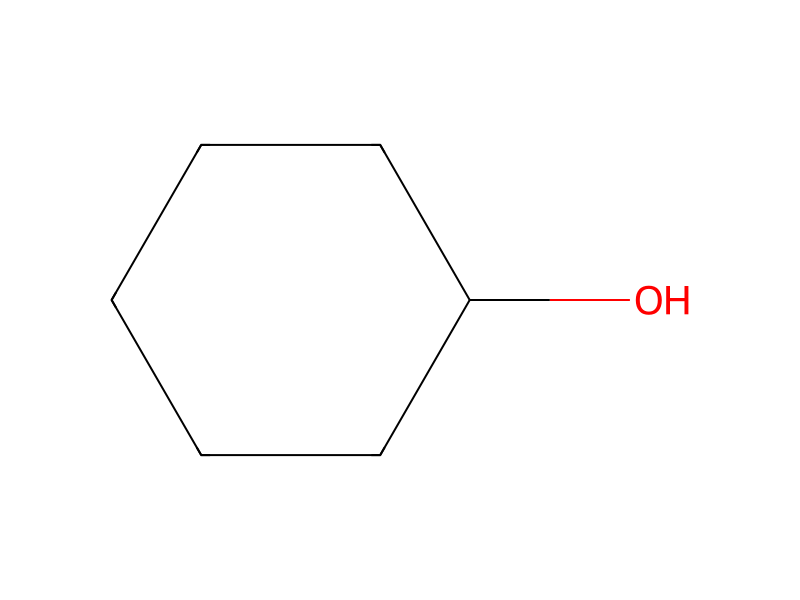
Cyclohexanol → Cyclohexanol
반응식
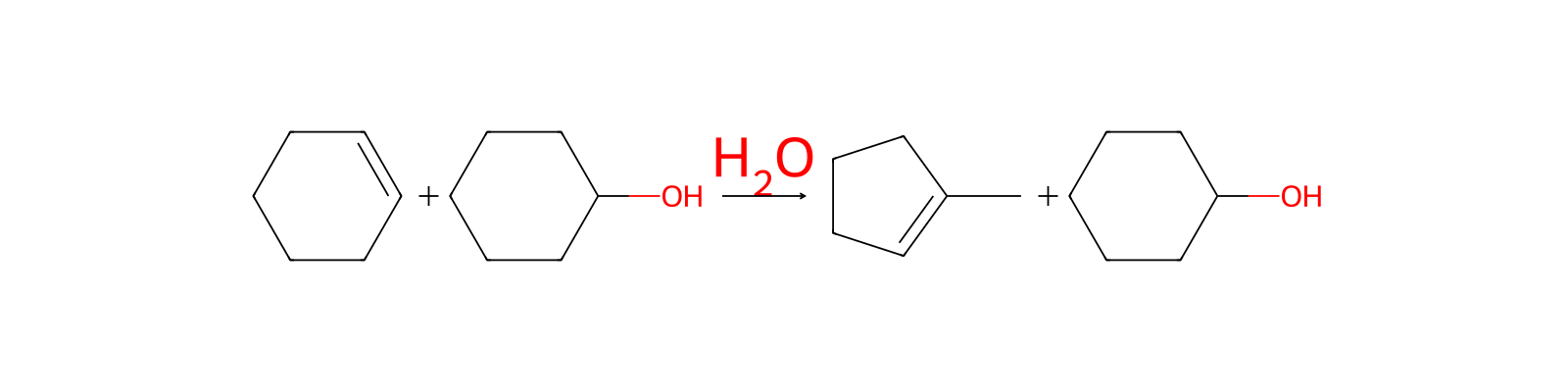
[CH:1]1[CH2:6][CH2:5][CH2:4][CH2:3][CH:2]=1.[CH:7]1([OH:13])[CH2:12][CH2:11][CH2:10][CH2:9][CH2:8]1>O>[CH3:1][C:6]1[CH2:5][CH2:4][CH2:3][CH:2]=1.[CH:7]1([OH:13])[CH2:12][CH2:11][CH2:10][CH2:9][CH2:8]1참가 물질
5



실험 절차
With respect to the manner of the hydration reaction, there is no particular limitation; the reaction can be performed in either of continuous and batchwise manners. The hydration reaction is generally performed as follows. Cyclohexene is added to a catalyst slurry comprising a hydration catalyst and water to effect hydration of cyclohexene in a suspension state to obtain a reaction mixture comprising an aqueous phase comprised of the catalyst slurry and an oil phase comprised of cyclohexanol produced and the cyclohexene remaining unreacted. The oil phase is phase-separated from the aqueous phase, and provided to a separation step. The aqueous phase containing the hydration catalyst can be recycled as the catalyst slurry to the reactor. In the hydration reaction, a small amount of methylcyclopentene is generally formed as a by-product as well as cyclohexanol as the desired intermediate. The oil phase, which contains the cyclohexanol, the methylcyclopentene and the cyclohexene, is separated into a high boiling point component containing cyclohexanol and a low boiling point component containing cyclohexene by a customary method, such as distillation. If desired, the separated cyclohexanol can be further subjected to treatment for isolation, thereby obtaining a cyclohexanol having a desired purity. In such a case, it is preferred that the obtained cyclohexanol has a purity of 99% or more. In general, it is preferred that the unreacted cyclohexene which is separated from cyclohexanol is subjected to treatment for isolation so as to obtain cyclohexene having a desired purity, followed by recycling thereof to the reactor.