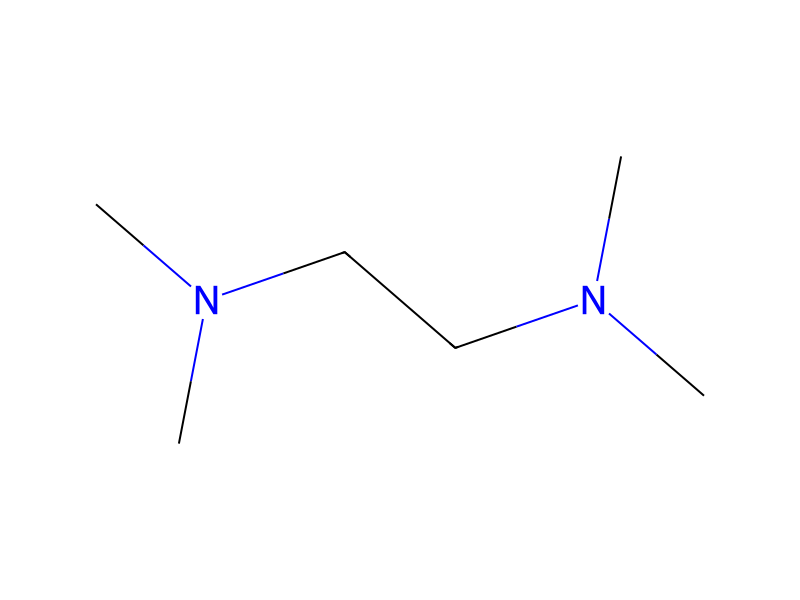
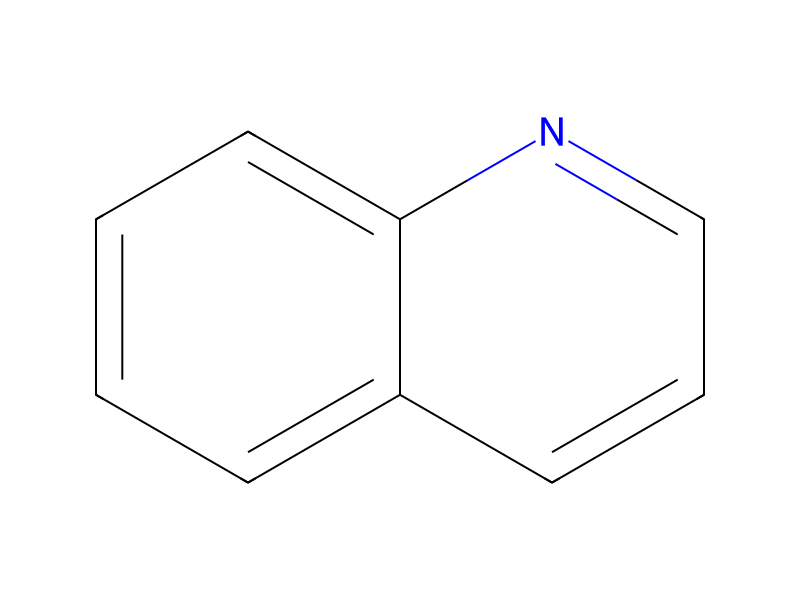
N,N,N',N'-Tetramethylethylenediamine → Quinoline
Reaction equation

[N+]12([O-])CCC(CC1)CC2.CN(CCN(C)C)C.C([Li])CCC.[N:23]1[C:32]2[C:27](=[CH:28][CH:29]=[CH:30][CH:31]=2)[C:26](C=O)=[CH:25][CH:24]=1>C(Cl)(Cl)Cl.CCCCCCC.C(O)(C)C>[N:23]1[C:32]2[C:27](=[CH:28][CH:29]=[CH:30][CH:31]=2)[CH:26]=[CH:25][CH:24]=1Participants





Procedure
The synthesis is carried out in a similar manner to Example A5 using 3.58 g (28.2 mmol) of azabicyclo[2.2.2]octane N-oxide, 4.70 ml (31.1 mmol) of TMEDA, 20.00 ml (32.0 mmol) of n-butyllithium (1.6 M in n-hexane) and 5.00 g (31.7 mmol) of quinoline-4-carbaldehyde. The 1H NMR spectrum of the crude product shows that the two diastereomers are formed in a 1:1 ratio. Chromatographic purification on a silica gel column (ethyl acetate/triethylamine, 9:1) provides 2.95 g (39%) of rubanol as a colourless solid. Semipreparative HPLC (Chiracel OD-H®, n-heptane/isopropanol 98:2, 0.5 ml/min, tr[(−)-rubanol]=52.1 min, tr[(+)-rubanol]=63.8 min) separates the erythro-enantiomers from each other to 99% ee in each case. 1H NMR (CDCl3, 400 MHz): 8.90 (d, 1H, 3J=4.6 Hz), 8.12 (dd, 1H, 3J=8.6 Hz, 4J=0.8 Hz), 7.97 (d, 1H, 3J=8.4 Hz), 7.69-7.64 (m, 2H), 7.43 (dt, 1H, 3J=7.0 Hz, 4J=1.2 Hz), 5.78 (d, 1H, 3J=3.5 Hz), 4.70 (br, 1H), 3.57-3.52 (m, 1H), 3.14-2.49 (m, 4H), 1.89-1.27 (m, 7H). 13C NMR (CDCl3, 101 MHz): 150.6 (q), 148.7 (t), 148.4 (q), 130.8 (t), 129.4 (t), 126.9 (t), 126.1 (t), 125.5 (q), 123.4 (t), 118.7 (t), 72.0 (t), 60.4 (t), 51.1 (s), 44.3 (s), 26.7 (s), 26.3 (s), 25.9 (s), 22.3 (t). Melting point: 222-224° C. [α]D20: +99° (c=0.51, CHCl3).
Workup
- customare formed in a 1:1 ratio
- customChromatographic purification on a silica gel column (ethyl acetate/triethylamine, 9:1)
- customprovides 2.95 g (39%) of rubanol as a colourless solid
Sources & evidence
- ORD record
- ord-106be1b604684b1087eed113f41285fb
- Source dataset
- uspto-grants-2004_09
- Patent number
- US06794532B2
Reaction notes
Loading…