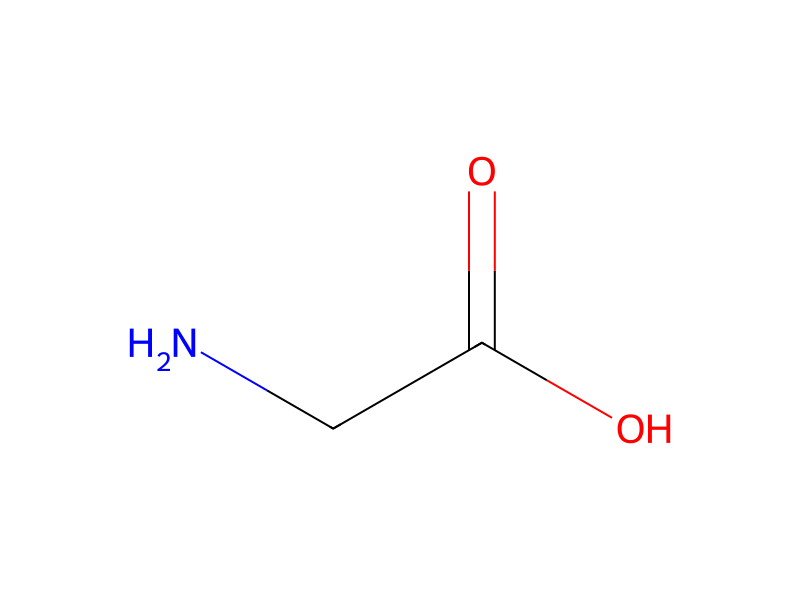
Glycine → L-Glutamic Acid
Reaction equation

NCC(NCC([NH:9][C@H:10]([C:16](NCC(NCC(O)=O)=O)=[O:17])[CH2:11][CH2:12][C:13](=[O:15])[OH:14])=O)=O.CC(CC(NC(C(NC(CNC(CNC(C(N)CC1C=CC(O)=CC=1)=O)=O)=O)CC1C=CC=CC=1)=O)C(O)=[O:33])C.NCC(O)=O>>[NH2:9][C@H:10]([C:16]([OH:17])=[O:33])[CH2:11][CH2:12][C:13]([OH:14])=[O:15]Participants


Procedure
FIG. 3 shows a product-ion spectrum of the [M+107Ag]+ ion of GGEGG (SEQ. ID. NO. 2), glycylglycylglutamylglycylglycine. Sequencing of the argentinated peptide is straightforward and similar to that discussed in Example 1 for leucine enkephalin. The difference in m/z values between the [M+107Ag]+ ion and the first [bn+OH+Ag]+ ion is 482.1−425.1=57.0, which identifies the C-terminal residue as glycine (theoretical Δm/z 57.0). The difference in m/z values between the first [bn+OH+Ag]+ and the second [bn+OH+Ag]+ is 425.1−368.0=57.1; this identifies the residue preceding the C-terminus as, again, glycine. Repeating the procedure yields the next residue, glutamic acid (experimental Δm/z=128.9 versus theoretical Δm/z=129.0). The triplet peak pattern disappears beyond glutamic acid; however, manual interpretation reveals further sequence information. The [a1−H+Ag]+ in this product-ion spectrum is weak. However, the small m/z value of the [a1−H+Ag]+ ion of the last triplet, 193.1, strongly suggests that it is the [a1−H+Ag]+ ion. This makes G-G as the only possible option for the N-terminal and second residues (theoretical m/z=193.0). Furthermore, FIG. 3 shows a small peak at m/z 136.0, which is assignable as the [a1−H+Ag]+ ion (theoretical m/z=136.0, assuming the first residue is glycine). Thus, the determined sequence is G-G-E-G-G (SEQ. ID. NO. 2).
Sources & evidence
- ORD record
- ord-6b3100ae24d5483191b100f67e41c3bb
- Source dataset
- uspto-grants-2004_09
- Patent number
- US06799121B2
Reaction notes
Loading…