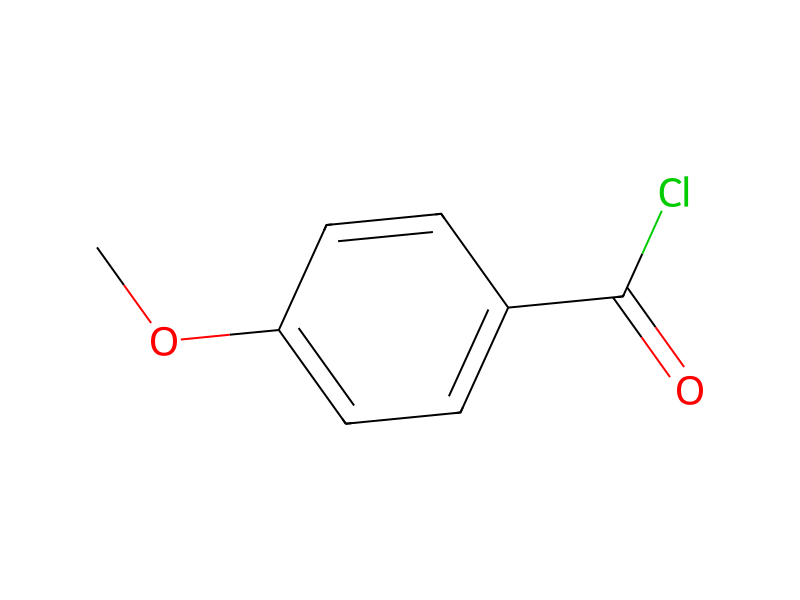
p-Anisoyl chloride → HCID 808296, compound
Reaction equation

C(N(CC)CC)C.[CH3:8][O:9][C:10]1[CH:18]=[CH:17][C:13]([C:14](Cl)=[O:15])=[CH:12][CH:11]=1.[F:19][C:20]1[CH:25]=[CH:24][C:23]([OH:26])=[CH:22][CH:21]=1.[OH-].[Na+]>C(Cl)(Cl)Cl.O.ClCCl>[CH3:8][O:9][C:10]1[CH:18]=[CH:17][C:13]([C:14]([O:26][C:23]2[CH:24]=[CH:25][C:20]([F:19])=[CH:21][CH:22]=2)=[O:15])=[CH:12][CH:11]=1Participants
8







Conditions
- Temperature
- 55 °C
Procedure
Triethylamine (6 mL) and a solution of 4.0 g of 4-methoxybenzoyl chloride (supplied from Tokyo Chemical Industry) in 40 mL of chloroform were added to a solution of 6.0 g of 4-fluorophenol (supplied from Tokyo Chemical Industry) in 60 mL of chloroform, and stirred at 55° C. for one hour. Then 100 mL of dichloromethane, 200 mL of water and 25 mL of an aqueous solution of 1 N sodium hydroxide were added to the reaction solution, and the mixture was separated into two liquid phases. The organic layer was dried on sodium sulfate anhydrate and subsequently concentrated, to yield 8.1 g of the title compound.
Workup
- customthe mixture was separated into two liquid phases
- customThe organic layer was dried on sodium sulfate anhydrate
- concentrationsubsequently concentrated
Sources & evidence
- ORD record
- ord-1855be5c86214de1a53c77eff014cbf8
- Source dataset
- uspto-grants-2011_07
- Patent number
- US07973030B2
Reaction notes
Loading…