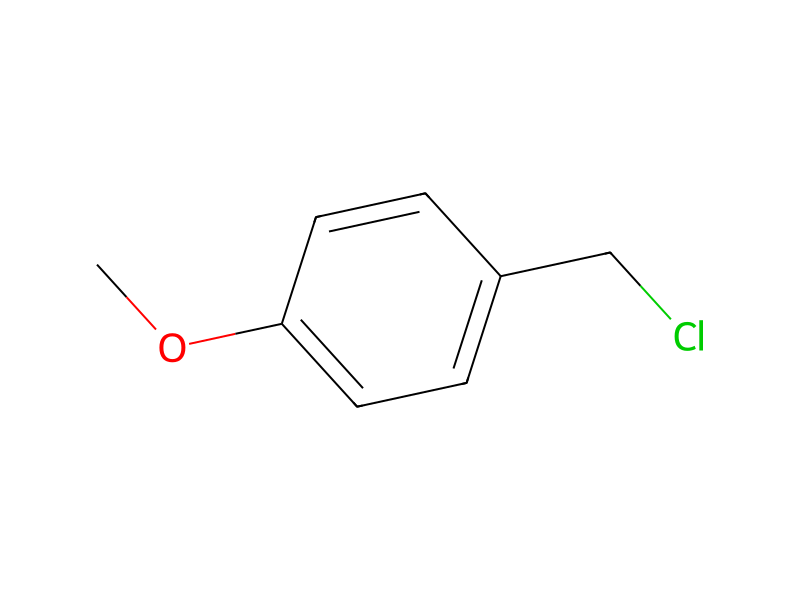
4-Methyloxybenzyl chloride → HCID 131728994, compound
Reaction equation

[C:1]([O:5][C:6]([NH:8][CH2:9][CH2:10][NH:11][CH2:12][C:13]1[CH:14]=[N:15][C:16]([Cl:19])=[CH:17][CH:18]=1)=[O:7])([CH3:4])([CH3:3])[CH3:2].C(N(C(C)C)CC)(C)C.[CH3:29][O:30][C:31]1[CH:36]=[CH:35][C:34]([CH2:37]Cl)=[CH:33][CH:32]=1>C(Cl)Cl>[C:1]([O:5][C:6]([NH:8][CH2:9][CH2:10][N:11]([CH2:12][C:13]1[CH:14]=[N:15][C:16]([Cl:19])=[CH:17][CH:18]=1)[CH2:37][C:34]1[CH:35]=[CH:36][C:31]([O:30][CH3:29])=[CH:32][CH:33]=1)=[O:7])([CH3:4])([CH3:2])[CH3:3]Participants
Reactant 3


Product 1

Reagents, catalysts & solvents 1

Procedure
A stirred solution of 1.5 grams (0.0052 mole) of (tert-butoxy)-N-(2-{[(6-chloro(3-pyridyl))methyl]amino}ethyl)carboxamide and 2.3 mL (0.013 mole) of diisopropylethyl amine in about 15 mL of methylene chloride was cooled to 0° C., and 0.7 mL (0.0052 mole) of (4-methoxyphenyl)methyl chloride in about 3 mL of methylene chloride was added dropwise. Upon completion of addition the reaction mixture was allowed to warm to ambient temperature, where it stirred during an 18 hour period. After this time, analysis of the reaction mixture by thin layer chromatography (TLC) indicated that no reaction had taken place. The reaction mixture was then heated at reflux for two hours, after which TLC analysis indicated that no reaction had taken place. The methylene chloride solvent was removed under reduced pressure from the reaction mixture, which was replaced with chloroform. The reaction mixture was heated at reflux during one hour, and then it was allowed to cool to ambient temperature, where it stirred during an 18 hour period. After this time TLC analysis indicated the presence of some reaction product. The reaction mixture was then heated at reflux for about a nine hour period and then it was allowed to cool to ambient temperature as it stirred during an additional 18 hour period. After this time the chloroform solvent was removed under reduced pressure from the reaction mixture, which was replaced with acetonitrile. The reaction mixture was then stirred at ambient temperature during a four hour period, warmed to 60° C. where it stirred for a ten hour period, and finally stirred at ambient temperature during a 60 hour period. The reaction mixture was concentrated under reduced pressure to a residue, and the residue was purified with column chromatography on silica gel. Elution was accomplished using 30% ethyl acetate in hexane. Appropriate fractions were combined and concentrated under reduced pressure, yielding 1.6 grams of the subject compound. The NMR spectrum was consistent with the proposed structure.
Workup
- additionUpon completion of addition the reaction mixture
- temperatureThe reaction mixture was then heated
- temperatureat reflux for two hours
- customThe methylene chloride solvent was removed under reduced pressure from the reaction mixture, which
- temperatureThe reaction mixture was heated
- temperatureat reflux during one hour
- temperatureto cool to ambient temperature
- stirringwhere it stirred during an 18 hour period
- temperatureThe reaction mixture was then heated
- temperatureat reflux for about a nine hour period
- temperatureto cool to ambient temperature as it
- stirringstirred during an additional 18 hour period
- customAfter this time the chloroform solvent was removed under reduced pressure from the reaction mixture, which
- stirringThe reaction mixture was then stirred at ambient temperature during a four hour period
- temperaturewarmed to 60° C. where it
- stirringstirred for a ten hour period
- stirringfinally stirred at ambient temperature during a 60 hour period
- concentrationThe reaction mixture was concentrated under reduced pressure to a residue
- customthe residue was purified with column chromatography on silica gel
- washElution
- concentrationconcentrated under reduced pressure
Sources & evidence
- ORD record
- ord-60e154b14b2e420d861e0c39a03671c3
- Source dataset
- uspto-grants-2011_07
- Patent number
- US07977332B2
Reaction notes
Loading…