Acetic Acid → 5-methoxy-2,3-dihydro-1H-indole
Reaction equation

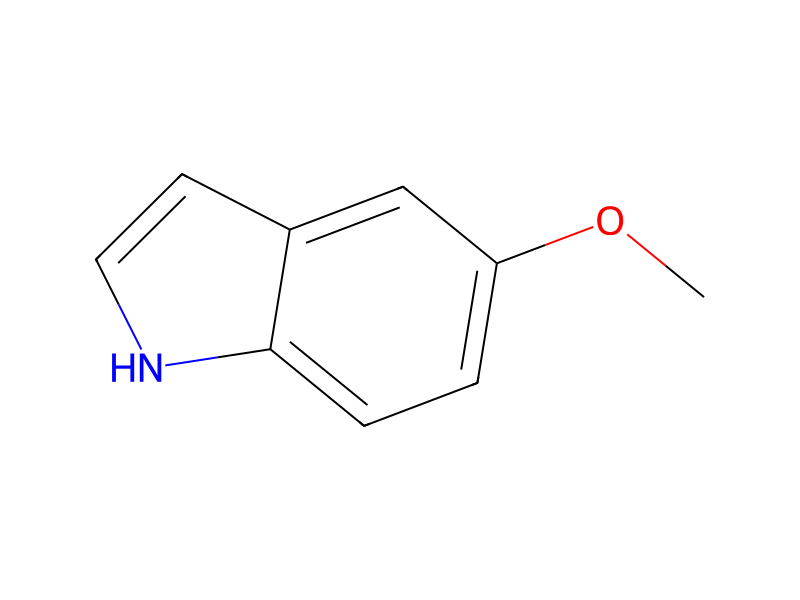
[CH3:1][O:2][C:3]1[CH:4]=[C:5]2[C:9](=[CH:10][CH:11]=1)[NH:8][CH:7]=[CH:6]2.C(O)(=O)C.C([BH3-])#N.[Na+].[OH-].[Na+]>O>[CH3:1][O:2][C:3]1[CH:4]=[C:5]2[C:9](=[CH:10][CH:11]=1)[NH:8][CH2:7][CH2:6]2Participants
Reactant 4



Product 1

Reagents, catalysts & solvents 1

Conditions
- Temperature
- 10 °C
Procedure
A 4-neck 22 L round bottom flask equipped with a nitrogen inlet, mechanical stirrer and thermowell was charged with commercially available 5-methoxyindole (750 g, 5.1 mol) and acetic acid (3.75 L). The resulting solution was cooled to 10° C. by ice bath. Sodium cyanoborohydride (640 g, 10.2 mol, 2 equiv) was added portionwise to maintain the reaction temperature below 25° C. Upon the completion of addition, the reaction was stirred at room temperature for 3 hours and then water was added slowly (2.2 L). The mixture was basified to pH>12 with 50% NaOH (˜5.3 L, slow addition to avoid foaming, the temperature kept below 30° C.). The resulting mixture was extracted with dichloromethane (2×12 L). The combined organic layers were dried over sodium sulfate and evaporated in vacuo to give 5-(methyloxy)-2,3-dihydro-1 H-indole (760 g, >90% purity), which was used for the next step without further purification. 1H NMR (CDCl3, 300 MHz) 6 6.76 (s, 1 H), 6.60 (s, 2H), 3.54 (t, 2H), 3.01 (t, 2H).
Workup
- customA 4-neck 22 L round bottom flask equipped with a nitrogen inlet, mechanical stirrer
- temperatureto maintain the reaction temperature below 25° C
- additionUpon the completion of addition
- addition˜5.3 L, slow addition
- customkept below 30° C.
- extractionThe resulting mixture was extracted with dichloromethane (2×12 L)
- dry with materialThe combined organic layers were dried over sodium sulfate
- customevaporated in vacuo
Sources & evidence
- ORD record
- ord-99f4c403104540419a86c6c649b27728
- Source dataset
- uspto-grants-2011_07
- Patent number
- US07981903B2
Reaction notes
Loading…