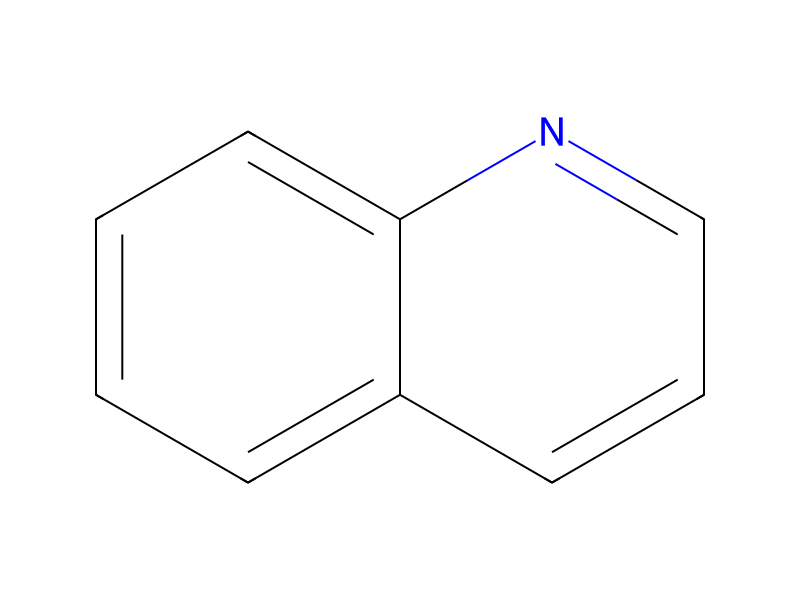
Quinoline → N-ethyl-N-methyl-2-[6-(methyloxy)-7-nitro-3,4-dihydro-1(2H)-quinolinyl]-2-oxoethanamine
Reaction equation

[CH3:1][O:2][C:3]1[CH:4]=[C:5]2[C:10](=[CH:11][C:12]=1[N+:13]([O-:15])=[O:14])[NH:9][CH2:8][CH2:7][CH2:6]2.[CH3:16][CH2:17][N:18]([CH:22](C)C)[CH:19](C)[CH3:20].BrCC(Cl)=[O:28].N1C2C(=CC=CC=2)C=CC=1.C(NC)C.C(=O)(O)[O-].[Na+]>C(OCC)(=O)C>[CH2:17]([N:18]([CH3:22])[CH2:19][C:20]([N:9]1[C:10]2[C:5](=[CH:4][C:3]([O:2][CH3:1])=[C:12]([N+:13]([O-:15])=[O:14])[CH:11]=2)[CH2:6][CH2:7][CH2:8]1)=[O:28])[CH3:16]Participants
Reactant 6





Product 1

Reagents, catalysts & solvents 1

Procedure
A solution of 6-(methyloxy)-7-nitro-1,2,3,4-tetrahydroquinoline (3.00 g, 14.41 mmol), Hunig's Base (12.55 mL, 72.0 mmol), and bromo-acetylchloride (1.500 mL, 18.01 mmol) was stirred at room temperature for 2 hours, at which time quinoline was observed to still remain. Additional bromo-acetylchloride (1.500 mL, 18.01 mmol) was added, the reaction was stirred an additional 5 hours, N-ethylmethylamine (12.38 mL, 144 mmol) was added, and the reaction was maintained for 16 hours at room temperature. The reaction was poured into saturated aqueous sodium bicarbonate and diluted with ethyl acetate. The organic layer was dried over sodium sulfate, taken to a residue under reduced pressure, and the residue was purified by silica gel chromatography to afford N-ethyl-N-methyl-2-[6-(methyloxy)-7-nitro-3,4-dihydro-1(2H)-quinolinyl]-2-oxoethanamine (2.02 g, 45.6% yield) as a dark red solid. 1H NMR (400 MHz, DMSO-d6) δ ppm 8.35 (s, 1 H), 7.18 (s, 1 H), 3.89 (s, 3 H), 3.75 (s, 2 H), 3.30 (s, 2 H), 2.81 (t, J=6.12 Hz, 2 H), 2.36-2.47 (m, 2 H), 2.19 (s, 3 H), 1.80-1.97 (m, 2 H), 0.86-1.02 (m, 3 H).
Workup
- dry with materialThe organic layer was dried over sodium sulfate
- customthe residue was purified by silica gel chromatography
Sources & evidence
- ORD record
- ord-90dd07fd921748afb227b8351d23c26e
- Source dataset
- uspto-grants-2011_07
- Patent number
- US07981903B2
Reaction notes
Loading…