L-Phenylalanine → (2S)-2-(fluoroamino)-3-phenylpropanoic acid
Reaction equation

[NH2:1][C@H:2]([C:10]([OH:12])=[O:11])[CH2:3][C:4]1[CH:9]=[CH:8][CH:7]=[CH:6][CH:5]=1.[F:13]C1C=CC(C[C@@H](C(O)=O)N)=CC=1.N[C@H](C(O)=O)CC[Se]C>>[F:13][NH:1][C@H:2]([C:10]([OH:12])=[O:11])[CH2:3][C:4]1[CH:9]=[CH:8][CH:7]=[CH:6][CH:5]=1Participants
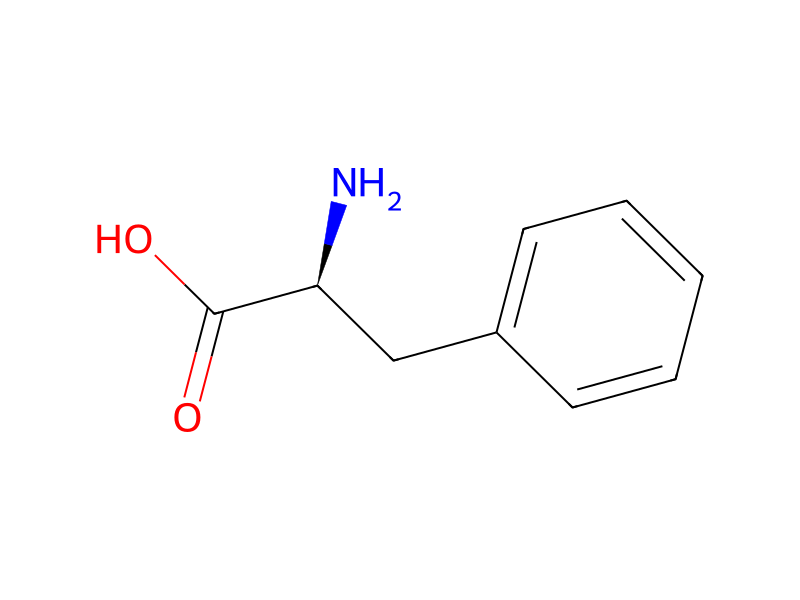


Procedure
Replacement of phenylalanine residues in a protein with p-fluoro-L-phenylalanine (F-Phe) can be implemented for the structural analysis of the protein by19F NMR8, 9. However, as with selenomethionine substitution, F-Phe substitution is cytotoxic. We followed the expression of the CspA in a manner analogous to that demonstrated for selenomethionine EnvZB. CspA was expressed with pColdI(SP4)cspA for 21 hr with and without the addition of F-Phe (FIG. 4A). The addition of F-Phe did not adversely affect CspA production in the SPP system. We then affinity purified the 86-residue CspA product and used mass spectroscopy to determine the extent of F-Phe substitution (FIGS. 4B,C). Although the endogenous Phe biosynthesis was not inhibited in the present SPP system, substantial incorporation of F-Phe (approximately 60 to 70% of total Phe residues) was observed, indicating that toxic F-Phe can be efficiently incorporated into a protein without affecting its yield.
Workup
- customWe then affinity purified the 86-residue CspA product
- customyield
Sources & evidence
- ORD record
- ord-3bb84a59155b49839580306f25c26e38
- Source dataset
- uspto-grants-2011_07
- Patent number
- US07985575B2
Reaction notes
Loading…