O-Phenylenediamine → HCID 135834135, compound
Reaction equation

C(O[C:4]([C:6]1[C:7](=[O:17])[NH:8][C:9]2[C:14]([CH:15]=1)=[CH:13][C:12]([Cl:16])=[CH:11][CH:10]=2)=O)C.[C:18]1([NH2:25])[CH:23]=[CH:22][CH:21]=[CH:20][C:19]=1[NH2:24].C(=O)(O)[O-].[Na+]>>[N:24]1[C:19]2[CH:20]=[CH:21][CH:22]=[CH:23][C:18]=2[NH:25][C:4]=1[C:6]1[C:7](=[O:17])[NH:8][C:9]2[C:14]([CH:15]=1)=[CH:13][C:12]([Cl:16])=[CH:11][CH:10]=2Participants
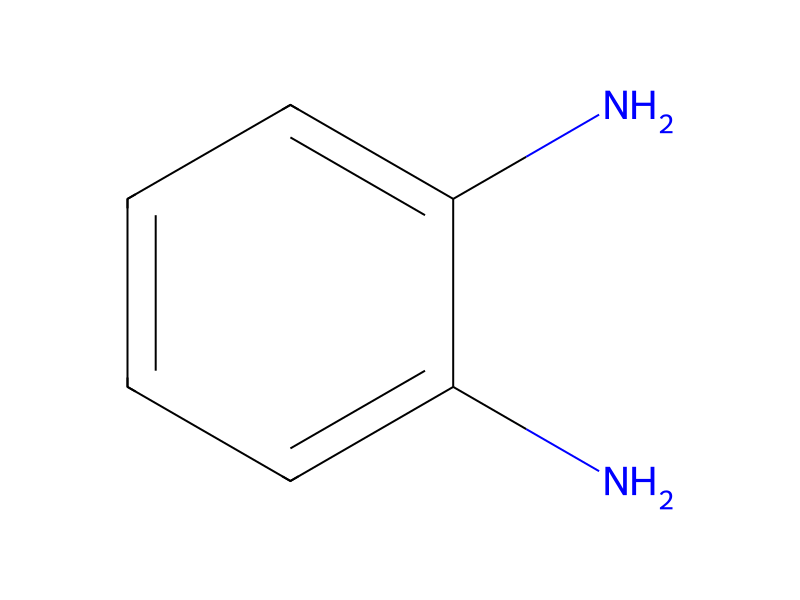



Conditions
- Temperature
- 200 °C
Procedure
A mixture of 6-chloro-2-oxo-1,2-dihydro-quinoline-3-carboxylic acid ethyl ester (7-2, 43 mg, 0.17 mmol, 1 equiv) and 1,2-phenylenediamine (37 mg, 0.34 mmol, 2.0 equiv) in polyphosphoric acid (3 mL) was heated at 200° C. for 2.5 h. The hot reaction mixture was poured into ice water (20 mL), and the resulting mixture was allowed to stand until all polyphosphoric acid had dissolved. The acidic suspension was neutralized with saturated aqueous sodium bicarbonate solution, then extracted with ethyl acetate (50 mL). The organic layer were dried over sodium sulfate and concentrated. The residue was suspended in ethyl ether (50 mL) aided by sonication, and the solids were filtered to give 3-(benzoimidazol-2-yl)-6-chloro-quinolin-2-one (7-3) as a yellow solid. 1H NMR (400 MHz, (CD3)2SO) δ 12.66 (br s, 1H), 12.58 (br s, 1H), 9.11 (s, 1H), 8.11 (d, 1H, J=2.2 Hz), 7.73 (m, 1H), 7.66 (m, 1H), 7.65 (dd, 1H, J=8.8, 2.4 Hz), 7.44 (d, 1H, J=8.8 Hz), 7.22 (m, 2H); HRMS (electrospray FT/ICR) calculated for C16H11N3O [M+H]+ 296.0591, found 296.0602.
Workup
- dissolutionhad dissolved
- extractionextracted with ethyl acetate (50 mL)
- dry with materialThe organic layer were dried over sodium sulfate
- concentrationconcentrated
- customaided by sonication
- filtrationthe solids were filtered
Sources & evidence
- ORD record
- ord-e641fb8298b64e76a8676f427c846699
- Source dataset
- uspto-grants-2002_11
- Patent number
- US06479512B1
Reaction notes
Loading…