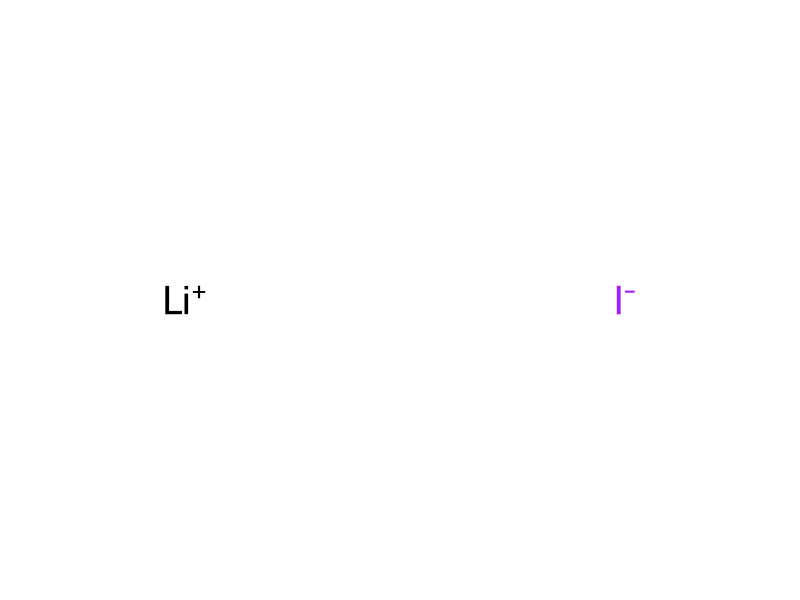
Lithium iodide → HCID 9863680, compound
Reaction equation

[Cl:1][C:2]1[CH:3]=[C:4]([S:9]([N:12]2[C:16]([C:17]([O:19]C)=[O:18])=[CH:15][C:14]3[O:21][CH:22]=[CH:23][C:13]2=3)(=[O:11])=[O:10])[CH:5]=[CH:6][C:7]=1[Cl:8].[I-].[Li+]>N1C=CC=CC=1>[Cl:1][C:2]1[CH:3]=[C:4]([S:9]([N:12]2[C:16]([C:17]([OH:19])=[O:18])=[CH:15][C:14]3[O:21][CH:22]=[CH:23][C:13]2=3)(=[O:10])=[O:11])[CH:5]=[CH:6][C:7]=1[Cl:8]Participants
4
Reactant 2

Product 1

Reagents, catalysts & solvents 1

Procedure
Methyl 4-(3,4-dichlorobenzenesulfonyl)furo[3,2-b]pyrrole-5-carboxylate (1.15 g) and lithium iodide (4.0 g) were dissolved in pyridine (50 ml) and heated at reflux for 5 hours, cooled, then concentrated in vacuo. The residue was partitioned between 2N HCl and ether. Combined organic extracts were dried (MgSO4), concentrated, and the residue triturated with ether to give the product as a white crystalline solid which was filtered and dried (0.58 g, 52%), NMR d(DMSO) 7.02 (1H, d), 7.27 (1H, s), 7.88 (2H, s), 8.03 (1H, d), 8.22 (1H, s); M/z (−) 360 (M+), 314, 252, 250, 227, 225, 209, 170. Analysis for C13H7Cl2NO5S found C, 43.2%; H, 2.1%; N, 3.8%; theory C, 41.4%; H, 2.0%; N, 3.9%.
Workup
- temperatureheated
- temperatureat reflux for 5 hours
- temperaturecooled
- concentrationconcentrated in vacuo
- customThe residue was partitioned between 2N HCl and ether
- dry with materialCombined organic extracts were dried (MgSO4)
- concentrationconcentrated
- customthe residue triturated with ether
Sources & evidence
- ORD record
- ord-1727559d20544f14a89c5fe4dadb37ff
- Source dataset
- uspto-grants-2002_11
- Patent number
- US06479527B1
Reaction notes
Loading…