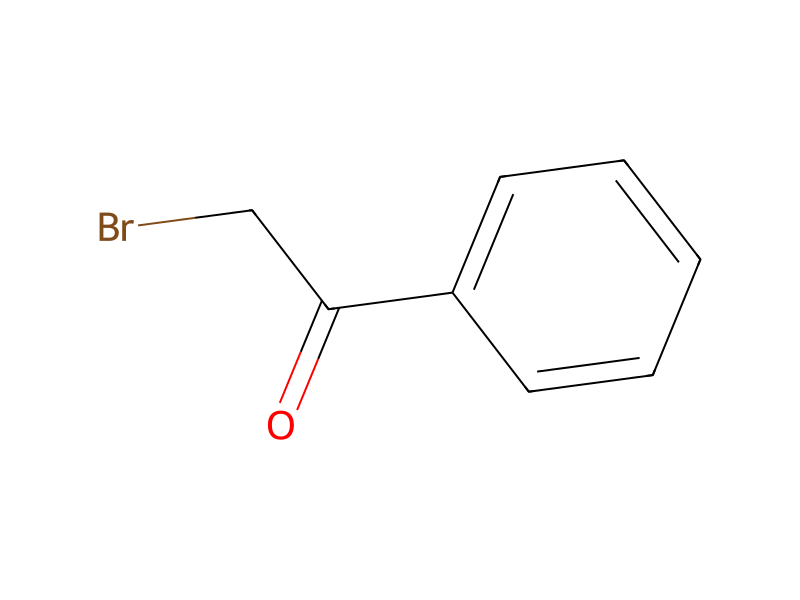
Phenacyl bromide → 2-Cycloheptylmethyl-5-naphthalen-2-yl-1H-pyrrole-3-carboxylic acid
Reaction equation

C([O:3][C:4](=[O:16])[CH2:5][C:6](=O)[CH2:7][CH:8]1[CH2:14][CH2:13][CH2:12][CH2:11][CH2:10][CH2:9]1)C.Br[CH2:18][C:19]([C:21]1[CH:30]=[CH:29][C:28]2[C:23](=[CH:24][CH:25]=[CH:26][CH:27]=2)[CH:22]=1)=O.BrCC(C1C=CC=CC=1)=O.C(OC[N:49]1C(C2C=C(N)C=CC=2)=NN=N1)(=O)C(C)(C)C.CNC[C@@H]([C@H]([C@@H]([C@@H](CO)O)O)O)O>O.O.O1CCOCC1.C(Cl)Cl>[CH:8]1([CH2:7][C:6]2[NH:49][C:19]([C:21]3[CH:30]=[CH:29][C:28]4[C:23](=[CH:24][CH:25]=[CH:26][CH:27]=4)[CH:22]=3)=[CH:18][C:5]=2[C:4]([OH:3])=[O:16])[CH2:9][CH2:10][CH2:11][CH2:12][CH2:13][CH2:14]1Participants
Reactant 5


Product 1

Reagents, catalysts & solvents 3



Procedure
2-Cycloheptylmethyl-5-naphthalen-2-yl-1H-pyrrole-3-carboxylic acid was prepared according to the procedure of Example 1, steps a, b and c, using 4-cycloheptyl-3-oxo-butyric acid ethyl ester and 2-bromo-1-naphthalen-2-yl-ethanone instead of 4-adamantan-1-yl-3-oxo-butyric acid ethyl ester and 2-bromo-1-phenyl-ethanone in step a. The acid was then reacted with 3-(1-pivaloyloxymethyl-1H-tetrazol-5-yl)-phenylamine using essentially the same procedure as in Example 1, step d. Deprotection was performed following essentially the procedure of Example 2, step b, with the exception that after acidification the product was isolated by extraction with DCM. 1H NMR (300 MHz, d6-DMSO) 11.63 (1H, s), 9.72 (1H, s), 8.59 (1H, s), 8.15 (1H, s), 7.88 (5H, m), 7.67 (2H, d), 7.48 (3H, m), 7.34 (1H, s), 2.95 (2H, d), 1.99 (1H, br s), 1.68-1.23 (12H, m). The acid was converted to the N-methyl-D-glucamine salt and lyophilised from water/dioxan. Found: C, 63.03; H, 6.96; N, 13.71%; C37H47N7O6.1.0 H2O requires: C, 63.14; H, 7.02; N, 13.93%.
Sources & evidence
- ORD record
- ord-ebcf834347c946ee8c3f3dba42026599
- Source dataset
- uspto-grants-2002_11
- Patent number
- US06479531B1
Reaction notes
Loading…