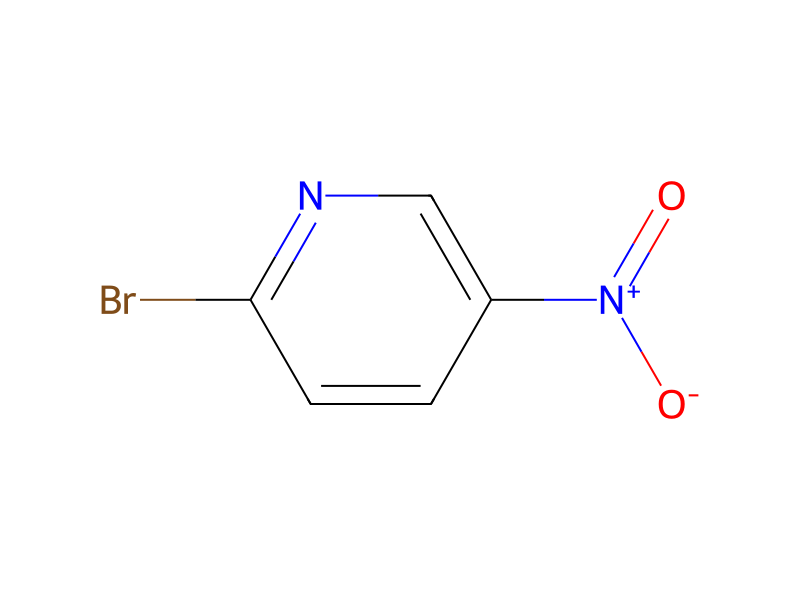
2-Bromo-5-nitropyridine → tert-Butyl 4-(5-nitropyridin-2-yl)piperazine-1-carboxylate
Reaction equation

Br[C:2]1[CH:7]=[CH:6][C:5]([N+:8]([O-:10])=[O:9])=[CH:4][N:3]=1.[N:11]1([C:17]([O:19][C:20]([CH3:23])([CH3:22])[CH3:21])=[O:18])[CH2:16][CH2:15][NH:14][CH2:13][CH2:12]1>C(#N)C>[N+:8]([C:5]1[CH:6]=[CH:7][C:2]([N:14]2[CH2:13][CH2:12][N:11]([C:17]([O:19][C:20]([CH3:23])([CH3:22])[CH3:21])=[O:18])[CH2:16][CH2:15]2)=[N:3][CH:4]=1)([O-:10])=[O:9]Participants
4
Reactant 2

Product 1

Reagents, catalysts & solvents 1

Procedure
A mixture of 2-bromo-5-nitropyridine (5.0 g, 24.6 mmol), tert-butyl piperazine-1-carboxylate (13.8 g, 74.2 mmol), acetonitrile (150 mL) was stirred at reflux for 2.5 h. After the reaction was completed, the solvent was removed under reduced pressure to afford 197a as a yellow solid (4.1 g, 54%). MS-ESI: [M+H]+ 309.
Workup
- temperatureat reflux for 2.5 h
- customthe solvent was removed under reduced pressure
Sources & evidence
- ORD record
- ord-3f6de6fc0ff941999820118658d615f8
- Source dataset
- uspto-grants-2014_05
- Patent number
- US08716274B2
Reaction notes
Loading…