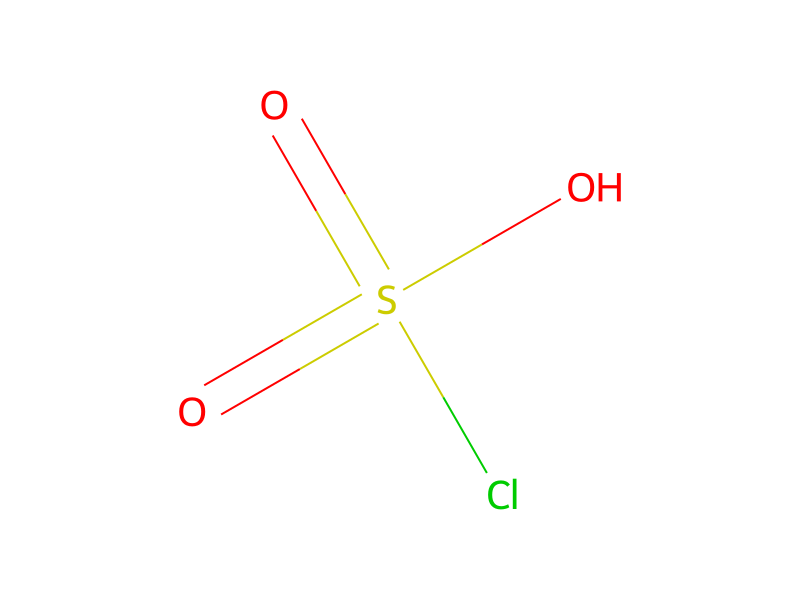
Chlorosulfonic acid → HCID 42633764, compound
Reaction equation

[Cl:1][S:2]([OH:5])(=O)=[O:3].[F:6][C:7]([F:22])([F:21])[C:8]1[N:12]=[CH:11][N:10]([C:13]2[CH:18]=[CH:17][C:16]([CH3:19])=[CH:15][C:14]=2[CH3:20])[N:9]=1>C(Cl)Cl>[F:22][C:7]([F:6])([F:21])[C:8]1[N:12]=[CH:11][N:10]([C:13]2[C:14]([CH3:20])=[CH:15][C:16]([CH3:19])=[C:17]([S:2]([Cl:1])(=[O:5])=[O:3])[CH:18]=2)[N:9]=1Participants
4
Reactant 2

Product 1

Reagents, catalysts & solvents 1

Conditions
- Temperature
- 45 °C
Procedure
Under a nitrogen atmosphere, 5 g of chlorosulphonic acid are introduced and are admixed at room temperature, in portions, with 3.6 g of 3-(trifluoromethyl)-1-(2,4-dimethylphenyl)-1H-1,2,4-triazole. The exothermic reaction raises the temperature of the mixture to around 45° C. The mixture is subsequently stirred at 70° C. for 3 hours and then cooled, and diluted with 20 ml of methylene chloride. The mixture is added with stirring to ice and then the phases are separated and washed with twice 20 ml of methylene chloride. The combined organic phases are concentrated on a rotary evaporator and then chromatographed (CH2Cl2). This gives 3.8 g of solid (76% of theory). This solid is reacted further directly.
Workup
- customThe exothermic reaction
- temperaturecooled
- additionThe mixture is added
- stirringwith stirring to ice
- customthe phases are separated
- washwashed with twice 20 ml of methylene chloride
- concentrationThe combined organic phases are concentrated on a rotary evaporator
- customchromatographed (CH2Cl2)
- customThis solid is reacted further directly
Sources & evidence
- ORD record
- ord-959d891a0c2a48c6932ba43c80bb13b5
- Source dataset
- uspto-grants-2014_05
- Patent number
- US08722717B2
Reaction notes
Loading…