Salicylaldehyde oxime → HCID 86710569, compound
Reaction equation

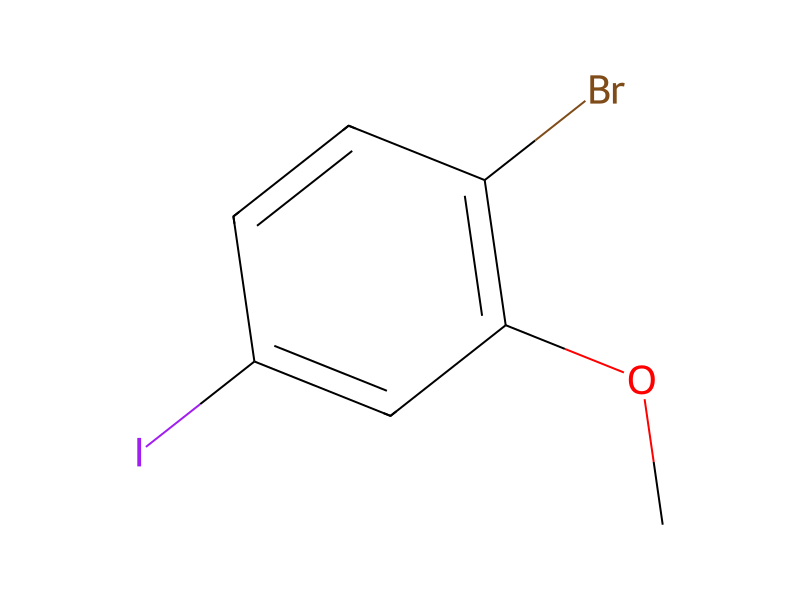
Cl.Cl.[NH:3]1[CH:7]=[C:6]([NH2:8])[CH:5]=[N:4]1.C(=NO)C1C(=CC=CC=1)O.C(=O)([O-])[O-].[Cs+].[Cs+].[Br:25][C:26]1[CH:31]=[CH:30][C:29](I)=[CH:28][C:27]=1[O:33][CH3:34]>CN(C)C=O>[Br:25][C:26]1[CH:31]=[CH:30][C:29]([N:3]2[CH:7]=[C:6]([NH2:8])[CH:5]=[N:4]2)=[CH:28][C:27]=1[O:33][CH3:34]Participants
6





Conditions
- Temperature
- 90 °C
Procedure
A mixture of pyrazole-4-amine dihydrochloride (0.75 g, 4.79 mmol), salicylaldoxime (0.131 g, 0.96 mmol), cesium carbonate (4.69 g, 14.38 mmol), cuprous oxide (0.06 g, 0.29 mmol), 1-bromo-4-iodo-2-methoxybenzene (1.5 g, 4.79 mmol) and N,N-dimethyl-formamide (5 mL) were combined in a microwave vial fitted with an N2 inlet and magnetic stir bar. The reaction mixture was stirred under a nitrogen atmosphere at 90° C. overnight. The solution obtained was allowed to cool to RT, then filtered through celite and the filtrate was concentrated in vacuo. The crude material was purified by silica gel chromotography (10% to 60% EtOAc in heptanes) to give 1-(4-bromo-3-methoxyphenyl)-1H-pyrazol-4-amine (250 mg, MS: 270.2 [M+H+].)
Workup
- customvial fitted with an N2 inlet and magnetic stir bar
- customThe solution obtained
- temperatureto cool to RT
- filtrationfiltered through celite
- concentrationthe filtrate was concentrated in vacuo
- customThe crude material was purified by silica gel chromotography (10% to 60% EtOAc in heptanes)
Sources & evidence
- ORD record
- ord-c9fd3502863a4db9b4f9aab4cc974de2
- Source dataset
- uspto-grants-2014_05
- Patent number
- US08729263B2
Reaction notes
Loading…