Water → (4S,5R)-5-[3,5-bis(trifluoromethyl)phenyl]-3-[(4-cyclopropyl-4'-fluoro-5'-isopropyl-2'-methoxybiphenyl-2-yl)methyl]-4-methyl-1,3-oxazolidin-2-one
Reaction equation

[F:1][C:2]([F:41])([F:40])[C:3]1[CH:4]=[C:5]([C@H:13]2[O:17][C:16](=[O:18])[N:15]([CH2:19][C:20]3[CH:25]=[C:24](Br)[CH:23]=[CH:22][C:21]=3[C:27]3[CH:32]=[C:31]([CH:33]([CH3:35])[CH3:34])[C:30]([F:36])=[CH:29][C:28]=3[O:37][CH3:38])[C@H:14]2[CH3:39])[CH:6]=[C:7]([C:9]([F:12])([F:11])[F:10])[CH:8]=1.[CH:42]1(B(O)O)[CH2:44][CH2:43]1.[OH-].[K+].O>O1CCOCC1.C1C=CC(P(C2C=CC=CC=2)[C-]2C=CC=C2)=CC=1.C1C=CC(P(C2C=CC=CC=2)[C-]2C=CC=C2)=CC=1.Cl[Pd]Cl.[Fe+2].C1C=CC([P]([Pd]([P](C2C=CC=CC=2)(C2C=CC=CC=2)C2C=CC=CC=2)([P](C2C=CC=CC=2)(C2C=CC=CC=2)C2C=CC=CC=2)[P](C2C=CC=CC=2)(C2C=CC=CC=2)C2C=CC=CC=2)(C2C=CC=CC=2)C2C=CC=CC=2)=CC=1>[F:1][C:2]([F:41])([F:40])[C:3]1[CH:4]=[C:5]([C@H:13]2[O:17][C:16](=[O:18])[N:15]([CH2:19][C:20]3[CH:25]=[C:24]([CH:42]4[CH2:44][CH2:43]4)[CH:23]=[CH:22][C:21]=3[C:27]3[CH:32]=[C:31]([CH:33]([CH3:35])[CH3:34])[C:30]([F:36])=[CH:29][C:28]=3[O:37][CH3:38])[C@H:14]2[CH3:39])[CH:6]=[C:7]([C:9]([F:12])([F:11])[F:10])[CH:8]=1Participants
Reactant 4


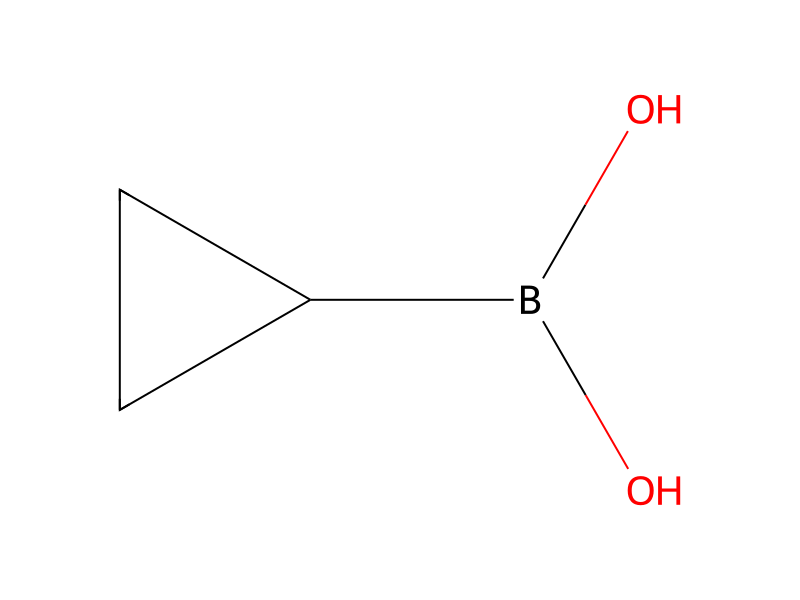

Product 1

Reagents, catalysts & solvents 3



Procedure
To a solution of (4S,5R)-5-[3,5-bis(trifluoromethyl)phenyl]-3-[(4-bromo-4′-fluoro-5′-isopropyl-2′-methoxybiphenyl-2-yl)methyl]-4-methyl-1,3-oxazolidin-2-one (100 mg, 0.15 mmol) in 1,4-dioxane (0.5 mL) was added cyclopropylboronic acid (10 mg, 0.19 mmol), [1,1′-bis(diphenylphosphino)ferrocene]dichloropalladium (II) (82 mg, 8 mol %), bis(tri-tert-butylphosphine)palladium (0) (10 mg, 13 mol %) and aqueous potassium hydroxide (78 μL, 3M, 1.5 eq.). The reaction mixture was purged with nitrogen and then sealed in a microwave vessel. The reaction vessel was subject to microwave irradiation at 150° C. for 30 min. An aliquot indicated complete consumption of starting material. Reaction crude was worked up with water. The resulting mixture was extracted with EtOAc and dried over Na2SO4. The titled compound was obtained as a glassy material after two preparative TLC plates using respectively 20% EtOAc in hexanes and 5% EtOAc in dichloromethane as the eluent. LC-MS: 610.26 (M+1)+. 1H NMR (CDCl3, 500 MHz) δ 1:1 mixture of rotamers δ 7.84 (s, 1 H), 7.65-7.70 (m, 2 H), 7.21 (s, 0.5 H), 7.08-7.14 (m, 1.5H), 6.95-7.04 (m, 2 H), 6.61-6.67 (m, 1 H), 5.52 (d, J=8.5 Hz, 0.5H), 5.27 (d, J=8.0 Hz, 0.5H), 4.85 (d, J=15.5 Hz, 0.5H), 4.81 (d, J=15.5 Hz, 0.5 H), 4.00 (d, J=15.5 Hz, 0.5 H), 3.69-3.81 (m, 4.5 H), 3.13-3.24 (m, 1H), 1.90-1.99 (m, 1 H), 1.12-1.30 (m, 6 H), 0.98-1.15 (m, 2 H), 0.71-0.77 (m, 2 H), 0.48 (d, J=6.5 Hz, 1.5 H), 0.29 (d, J=6.5 Hz, 1.5 H).
Workup
- customThe reaction mixture was purged with nitrogen
- customsealed in a microwave vessel
- customirradiation at 150° C. for 30 min
- customconsumption of starting material
- customReaction crude
- extractionThe resulting mixture was extracted with EtOAc
- dry with materialdried over Na2SO4
Sources & evidence
- ORD record
- ord-e88fee50a1e24f3696efb5bde10a9b97
- Source dataset
- uspto-grants-2014_05
- Patent number
- US08735435B2
Reaction notes
Loading…