Hydrochloric Acid → HCID 178527819, compound
Reaction equation

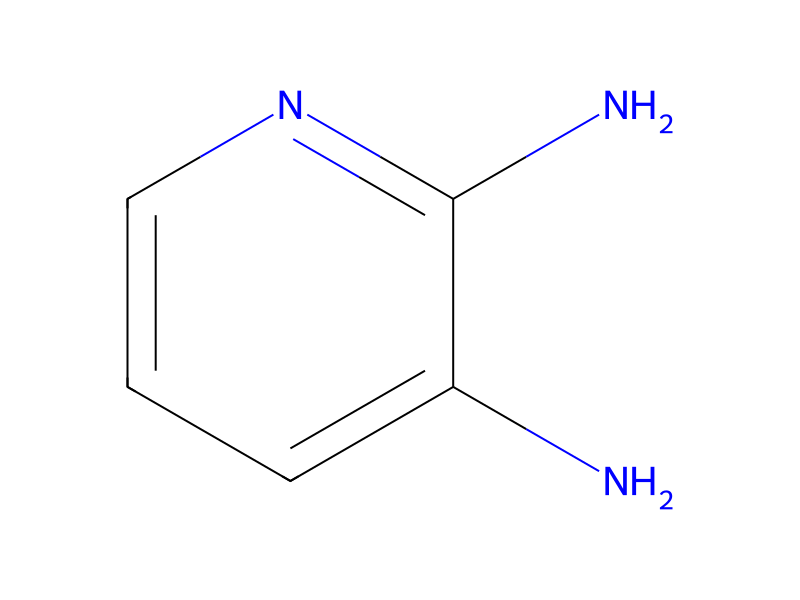
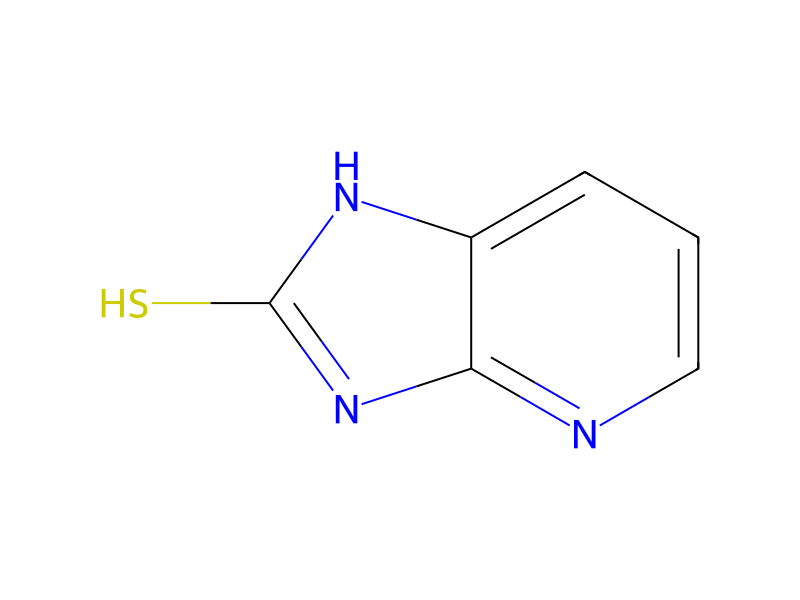
[NH2:1][C:2]1[C:7]([NH2:8])=[CH:6][CH:5]=[CH:4][N:3]=1.[OH-].[K+].[C:11](=S)=[S:12].Cl>C(Cl)Cl.O.C(O)C>[SH:12][C:11]1[NH:8][C:7]2[CH:6]=[CH:5][CH:4]=[N:3][C:2]=2[N:1]=1Participants






Procedure
A solution of 2,3-diaminopyridine (10.0 g, 92 mmol), potassium hydroxide (6.8 g, 123 mmol)k, CS2 (9.4 g, 123 mmol), ethanol (100 mL), and water (20 mL) was stirred at reflux for 5 hours, then at ambient temperature overnight. Evaporation in vacuo gave a residue which was dissolved in CH2Cl2, acidified to pH 5 with 2N hydrochloric acid, and stirred for 1 hour. The resultant suspension was filtered to give 15.7 g of 2-mercaptoimidazopyridine as a brown solid. A solution of the 2-mercaptoimidazopyridine (4.23 g, 28 mmol) and geranyl chloride (4.8 g, 28 mmol) in methanol (40 mL) and 2N NaOH/H2O (40 mmol) was stirred in 16 hours at ambient temperature, evaporated, dissolved in CH2Cl2, washed with water, and dried over Na2SO4. Flash chromatography (Merck Kieselgel, 5% MeOH/CH2Cl2) gave 2.0 g (25%) of 2-[(3,7-dimethyl-2,6(E)-octadienyl)thio]-1H-imidazo[4,5-6]pyridine, 1.0 g of which was converted to its oxalate salt. m.p. 118°-121° C. NMR (DMSO-d6)δ8.20(d, J=5 Hz, 1H), 7.60(m, 2H), 5.40(d, J=7 Hz, 1H), 5.10(d, J=6 Hz, 1H), 4.00(d, J=6 Hz, 2H), 2.00(m, 4H), 1.70(s, 3H), 1.61(s, 3H), 1.60(s, 3H).
Workup
- temperatureat reflux for 5 hours
- customat ambient temperature
- customovernight
- customEvaporation in vacuo
- customgave a residue which
- filtrationThe resultant suspension was filtered
Sources & evidence
- ORD record
- ord-b6fd145fe106401d8aeab17305dcf329
- Source dataset
- uspto-grants-1992_04
- Patent number
- US05106863
Reaction notes
Loading…