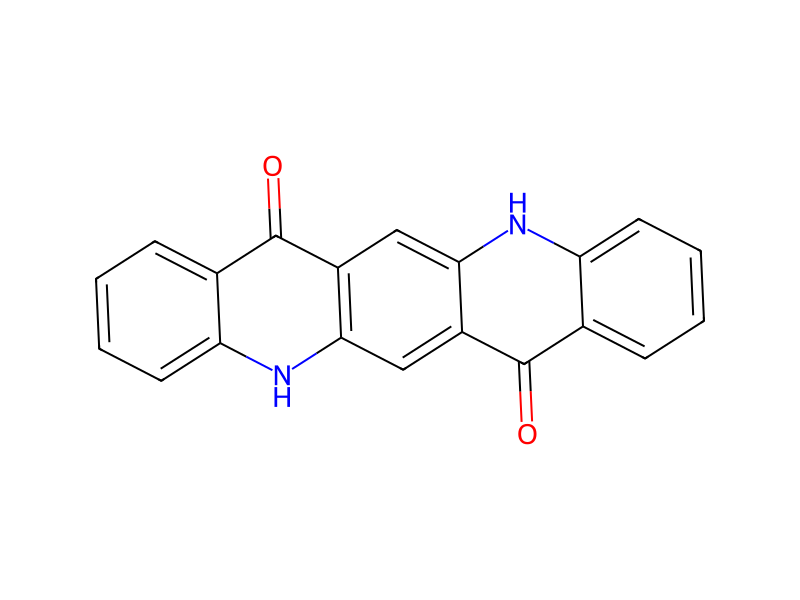
1,4-Cyclohexadiene-1,4-dicarboxylic acid, 2,5-bis(phenylamino)-, diethyl ester → Quinacridone
Reaction equation

[NH:1]([C:8]1[CH2:18][C:17]([C:19](OCC)=[O:20])=[C:16]([NH:24][C:25]2[CH:30]=[CH:29][CH:28]=[CH:27][CH:26]=2)[CH2:15][C:9]=1[C:10](OCC)=[O:11])[C:2]1[CH:7]=[CH:6][CH:5]=[CH:4][CH:3]=1>O>[CH:28]1[CH:29]=[C:30]2[C:19]([C:17]3[C:16]([NH:24][C:25]2=[CH:26][CH:27]=1)=[CH:15][C:9]1[C:10]([C:3]2[C:2]([NH:1][C:8]=1[CH:18]=3)=[CH:7][CH:6]=[CH:5][CH:4]=2)=[O:11])=[O:20]Participants
3
Reactant 1

Product 1
Reagents, catalysts & solvents 1

Procedure
A suspension of 250 g of diethyl 2,5-dianilino-3,6-dihydroterephthalate in 1 l of water was metered at 650° C. in the course of 1 hour in a nitrogen stream (1.5 m3) through a one-material nozzle into a tubular reactor (50 mm in diameter, 300 mm in length) in a axial direction. Using a wet collector, 183 g of quinacridone were isolated.
Workup
- customwas metered at 650° C. in the course of 1 hour in a nitrogen stream (1.5 m3) through a one-material nozzle into a tubular reactor
Sources & evidence
- ORD record
- ord-9ac7e638eddf4563bbdddf6896bad086
- Source dataset
- uspto-grants-1990_09
- Patent number
- US04956464
Reaction notes
Loading…