4-Fluoroiodobenzene → 4,4'-Difluorodiphenyl
Reaction equation

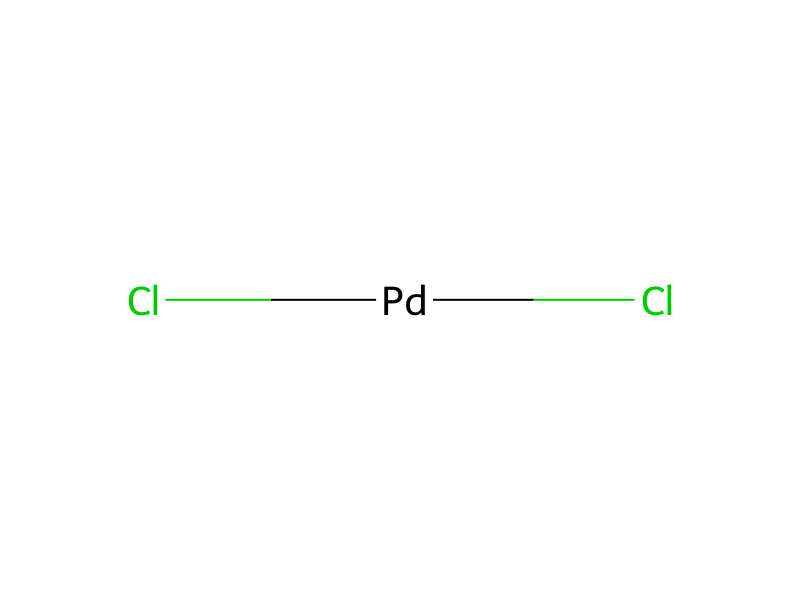
I[C:2]1[CH:7]=[CH:6][C:5]([F:8])=[CH:4][CH:3]=1.Br[C:10]1[CH:15]=[CH:14][C:13]([F:16])=[CH:12][CH:11]=1>[Pd].[Pd](Cl)Cl>[F:8][C:5]1[CH:6]=[CH:7][C:2]([C:10]2[CH:15]=[CH:14][C:13]([F:16])=[CH:12][CH:11]=2)=[CH:3][CH:4]=1Participants
Reactant 2


Product 1

Reagents, catalysts & solvents 2

Procedure
4,4'-difluorobiphenyl has heretofore been prepared by a process utilizing a Grignard coupling reaction. In accordance with the prior process, p-halofluorobenzene is reacted with magnesium in a solvent to form halomagnesiumfluorobenzene, the Grignard reagent. The Grignard reagent is then reacted with additional p-halofluorobenzene (the coupling reagent) in the presence of a catalyst comprised of palladium chloride or palladium supported on charcoal. This prior process results in a yield of about 80% 4-4'-difluorobiphenyl when the Grignard reagent is formed from pbromofluorobenzene and the coupling reagent is p-iodofluorobenzene. In addition, about 8% of a difluoroterphenyl byproduct is formed in the reaction. Thus, the heretofore utilized process produces a relatively low yield of 4,4'-difluorobiphenyl. In addition, the process is disadvantageous in that p-iodofluorobenzene is expensive, and a high molar ratio of the palladium chloride or palladium/charcoal catalyst is required. While p-bromofluorobenzene is much less expensive than p-iodofluorobenzene, when p-bromofluorobenzene is substituted for p-iodofluorobenzene in the coupling reaction, a very low yield of 4,4'-difluorobiphenyl is obtained.
Sources & evidence
- ORD record
- ord-395fe8f31471469680bc4359271881e2
- Source dataset
- uspto-grants-1990_09
- Patent number
- US04956507
Reaction notes
Loading…