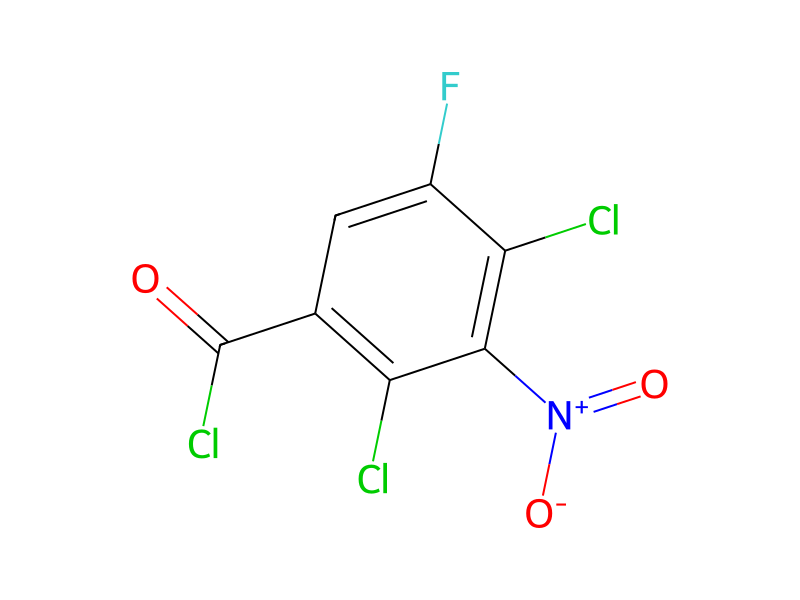
Thionyl Chloride → Benzoyl chloride, 2,4-dichloro-5-fluoro-3-nitro-
Reaction equation

[Cl:1][C:2]1[C:10]([N+:11]([O-:13])=[O:12])=[C:9]([Cl:14])[C:8]([F:15])=[CH:7][C:3]=1[C:4](O)=[O:5].S(Cl)([Cl:18])=O>>[Cl:1][C:2]1[C:10]([N+:11]([O-:13])=[O:12])=[C:9]([Cl:14])[C:8]([F:15])=[CH:7][C:3]=1[C:4]([Cl:18])=[O:5]Participants
3


Procedure
106.6 g of 2,4-dichloro-5-fluoro-3-nitrobenzoic acid are heated to boiling under reflux with 250 ml of thionyl chloride for 2 hours. The excess thionyl chloride is then removed by distillation under atmospheric pressure, and the residue is fractionated under high vacuum. 104.7 g of 2,4-dichloro-5-fluoro-3-nitrobenzoylchloride distil over at 110°-115° C./0.08-0.09 mbar. Crystals of melting point 35°-37° C. form on standing.
Workup
- customThe excess thionyl chloride is then removed by distillation under atmospheric pressure
- custom104.7 g of 2,4-dichloro-5-fluoro-3-nitrobenzoylchloride distil over at 110°-115° C./0.08-0.09 mbar
Sources & evidence
- ORD record
- ord-5f4fe67ee3784ff698ab2310b3250e96
- Source dataset
- uspto-grants-1990_09
- Patent number
- US04958045
Reaction notes
Loading…