Diethyl Ether → HCID 9989904, compound
Reaction equation

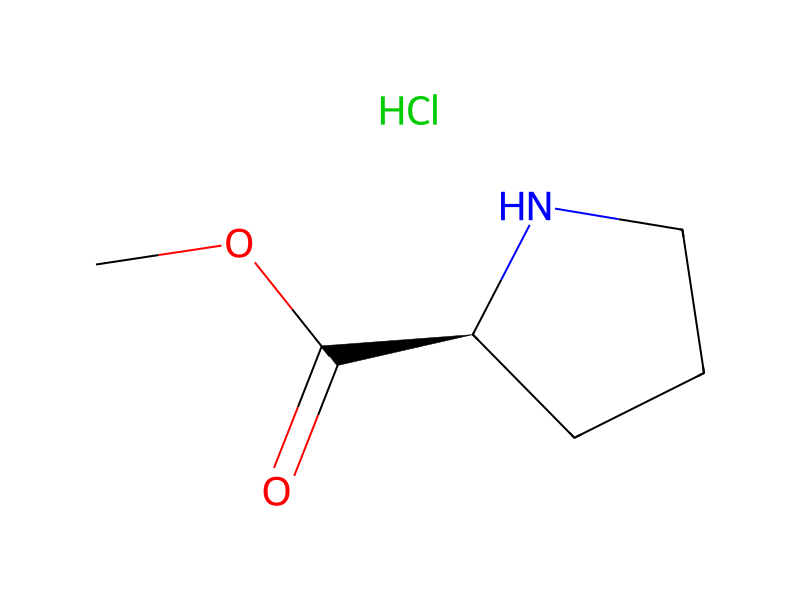
Cl.[CH3:2][O:3][C:4](=[O:10])[C@@H:5]1[CH2:9][CH2:8][CH2:7][NH:6]1.C(N(CC)CC)C.[C:18](Cl)(=[O:21])[CH:19]=[CH2:20].C(OCC)C>C(Cl)Cl>[O:21]=[C:18]([N:6]1[CH2:7][CH2:8][CH2:9][CH:5]1[C:4]([O:3][CH3:2])=[O:10])[CH:19]=[CH2:20]Participants
Reactant 4



Product 1

Reagents, catalysts & solvents 1

Conditions
- Temperature
- 5 °C
Procedure
L-Proline methyl ester hydrochloride (8.27 g, 0.05 mole) was dissolved in 250 ml of methylene chloride and triethylamine (40 ml, 0.28 mole) added thereto. The solution was filtered to remove the precipitate and cooled to 5° C. Over a period of 30 minutes, a solution of acryloyl chloride (4.52 g, 0.05 mole) was added to the cooled solution, the reaction allowed to warm to room temperature and stirred for 12 hours. Ethyl ether (100 ml) was then added to the solution and the resulting white solid filtered. An additional 200 ml of ethyl ether was added and a small amount of tan solid filtered out. The solvents were evaporated, and the resulting oil chromatographed on silica to isolate the product. The product was dried in vacuo at room temperature for 72 hours. The structure was confirmed by NMR.
Workup
- filtrationThe solution was filtered
- customto remove the precipitate
- temperatureto warm to room temperature
- filtrationthe resulting white solid filtered
- additionAn additional 200 ml of ethyl ether was added
- filtrationa small amount of tan solid filtered out
- customThe solvents were evaporated
- customthe resulting oil chromatographed on silica
- customto isolate the product
- customThe product was dried in vacuo at room temperature for 72 hours
Sources & evidence
- ORD record
- ord-5c19c6c295974e708331ed32347d59b7
- Source dataset
- uspto-grants-1990_09
- Patent number
- US04959364
Reaction notes
Loading…