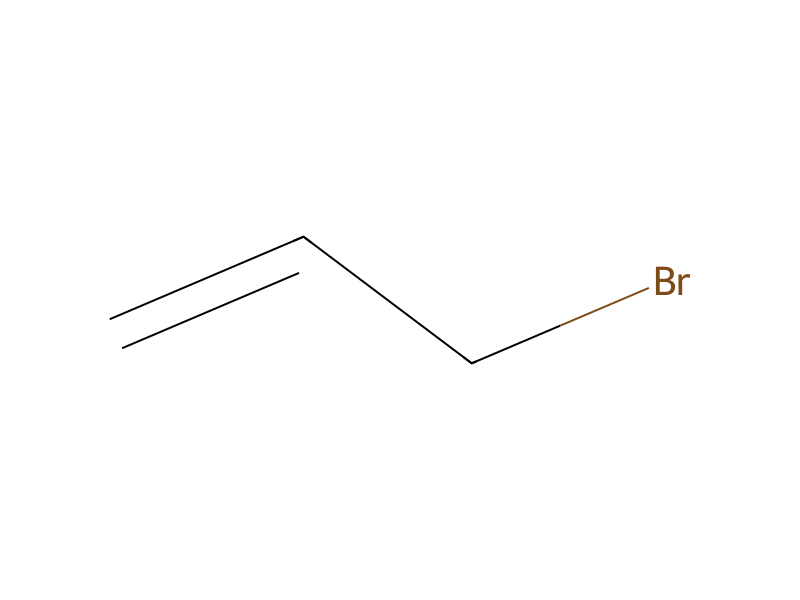
Allyl bromide → Methyl 2-hydroxy-4-[(prop-2-en-1-yl)oxy]benzoate
Reaction equation

[OH:1][C:2]1[CH:11]=[C:10]([OH:12])[CH:9]=[CH:8][C:3]=1[C:4]([O:6][CH3:7])=[O:5].[CH2:13](Br)[CH:14]=[CH2:15].C(=O)([O-])[O-].[K+].[K+]>CC(C)=O>[OH:1][C:2]1[CH:11]=[C:10]([O:12][CH2:15][CH:14]=[CH2:13])[CH:9]=[CH:8][C:3]=1[C:4]([O:6][CH3:7])=[O:5]Participants
5
Reactant 3


Product 1

Reagents, catalysts & solvents 1

Procedure
Methyl 2,4-dihydroxybenzoate (25 g, 148.7 mmol), allyl bromide (18.2 g, 150 mmol), and potassium carbonate (30.8 g, 22.3 mmol) were added to about 250 ml of acetone and the reaction mixture was refluxed with stirring overnight. The reaction mixture was filtered and concentrated. Separation of the pure compound was achieved by chromatography on silica gel using a Waters Prep 500™ and a 20% ethyl acetate/80% hexane solvent system.
Workup
- temperaturethe reaction mixture was refluxed
- filtrationThe reaction mixture was filtered
- concentrationconcentrated
- customSeparation of the pure compound
Sources & evidence
- ORD record
- ord-8d94f03318c34ebda671578f4f9c2cc4
- Source dataset
- uspto-grants-1994_05
- Patent number
- US05310951
Reaction notes
Loading…