Hydroquinone → HCID 19894591, compound
Reaction equation

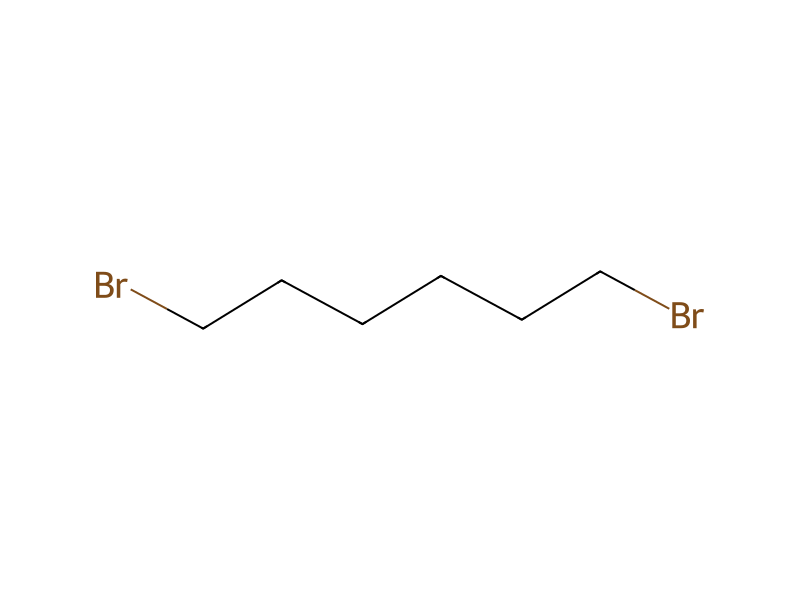
[C:1]1([CH:8]=[CH:7][C:5]([OH:6])=[CH:4][CH:3]=1)[OH:2].[Br:9][CH2:10][CH2:11][CH2:12][CH2:13][CH2:14][CH2:15]Br.[OH-].[K+]>CO>[Br:9][CH2:10][CH2:11][CH2:12][CH2:13][CH2:14][CH2:15][O:2][C:1]1[CH:8]=[CH:7][C:5]([OH:6])=[CH:4][CH:3]=1Participants
Reactant 3


Product 1

Reagents, catalysts & solvents 1

Procedure
As shown in the following Scheme, hydroquinone (1) (4.5 g (grams)) and 1,6-dibromo hexane (2) (10 g (grams)) were dissolved in methanol (100 ml (milliliters)) at a room temperature. Potassium hydroxide (2.3 g (grams)) was added to the resulting mixture solution, and then fluxed at 60° C. (Celsius) overnight. Next day, the temperature of the reaction mixture is lowered to a room temperature, and methanol was evaporated from the reaction mixture. Then, the reaction mixture was extracted three times with water (100 ml (milliliters)) and ethyl acetate (100 ml (milliliters)). Water was removed over magnesium sulfate, and the solvents were evaporated, and the resulting reaction mixture was purified using a column chromatography (developer solution: ethylacetate/hexane=1/5 volume ratio) to obtain 4.4 g (grams) of 4-(6-bromohexyloxy)phenol (3).
Workup
- customfluxed at 60° C.
- custom(Celsius) overnight
- customis lowered to a room temperature
- custommethanol was evaporated from the reaction mixture
- extractionThen, the reaction mixture was extracted three times with water (100 ml (milliliters)) and ethyl acetate (100 ml (milliliters))
- customWater was removed over magnesium sulfate
- customthe solvents were evaporated
- customthe resulting reaction mixture
- customwas purified
Sources & evidence
- ORD record
- ord-87ba805f1ada4c0cb0c7fe7447ad93d2
- Source dataset
- uspto-grants-2013_10
- Patent number
- US08545717B2
Reaction notes
Loading…