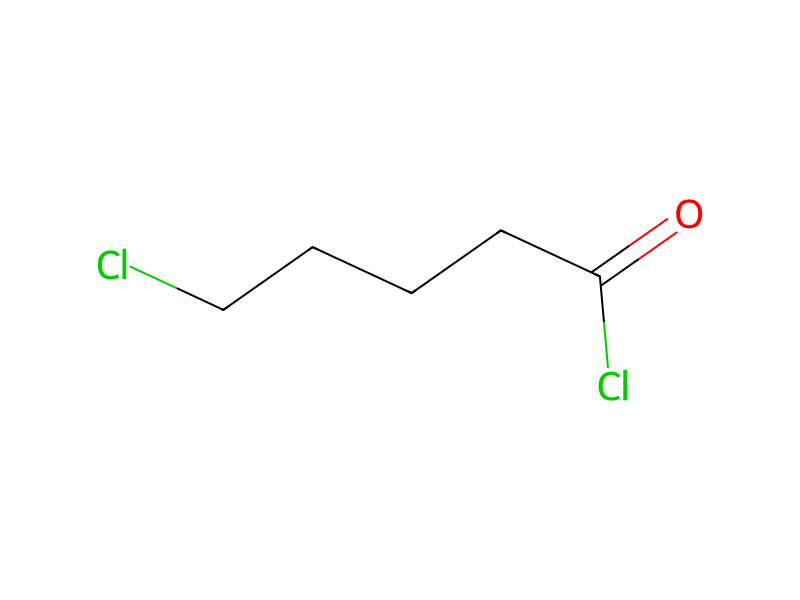
5-Chlorovaleryl chloride → HCID 69192083, compound
Reaction equation

[NH2:1][C:2]1[N:6]([CH3:7])[N:5]=[C:4]([CH3:8])[C:3]=1[C:9]#[N:10].[Cl:11][CH2:12][CH2:13][CH2:14][CH2:15][C:16](Cl)=[O:17]>N1C=CC=CC=1>[Cl:11][CH2:12][CH2:13][CH2:14][CH2:15][C:16]([NH:1][C:2]1[N:6]([CH3:7])[N:5]=[C:4]([CH3:8])[C:3]=1[C:9]#[N:10])=[O:17]Participants
4
Reactant 2

Product 1

Reagents, catalysts & solvents 1

Procedure
To a solution of 5-amino-1,3-dimethyl-1H-pyrazole-4-carbonitrile (1.59 g, 11.67 mmol) in anhydrous pyridine (15 mL) was slowly added 5-chlorovaleryl chloride (1.80 mL, 14.0 mmol) at 0° C. After addition, the reaction mixture was allowed to warm up to rt and stir at rt overnight. The reaction mixture was concentrated on a rotavapor and the residue was partitioned between ethyl acetate and brine. The organic phase was washed with brine and concentrated. The residue was separated by flash chromatography (silica gel, 50-80% gradient EtOAc in hexane) to provide Example 96A. Yield: 2.42 g (81%). MS (DCI): m/z 255 (M+H)+.
Workup
- customat 0° C
- additionAfter addition
- concentrationThe reaction mixture was concentrated on a rotavapor
- customthe residue was partitioned between ethyl acetate and brine
- washThe organic phase was washed with brine
- concentrationconcentrated
- customThe residue was separated by flash chromatography (silica gel, 50-80% gradient EtOAc in hexane)
- customto provide Example 96A
Sources & evidence
- ORD record
- ord-7fa01b2f19a044f5bebf46ffb88ccd33
- Source dataset
- uspto-grants-2013_10
- Patent number
- US08546368B2
Reaction notes
Loading…