2-(4-Fluorophenyl)acetic acid → 2-[(4-Fluorophenyl)acetyl]hydrazinecarbothioamide
Reaction equation

[F:1][C:2]1[CH:7]=[CH:6][C:5]([CH2:8][C:9]([OH:11])=O)=[CH:4][CH:3]=1.[NH2:12][NH:13][C:14]([NH2:16])=[S:15].OC1C2N=NNC=2C=CC=1.Cl.C(N=C=NCCCN(C)C)C>ClCCl>[F:1][C:2]1[CH:7]=[CH:6][C:5]([CH2:8][C:9]([NH:12][NH:13][C:14](=[S:15])[NH2:16])=[O:11])=[CH:4][CH:3]=1Participants
6
Reactant 4

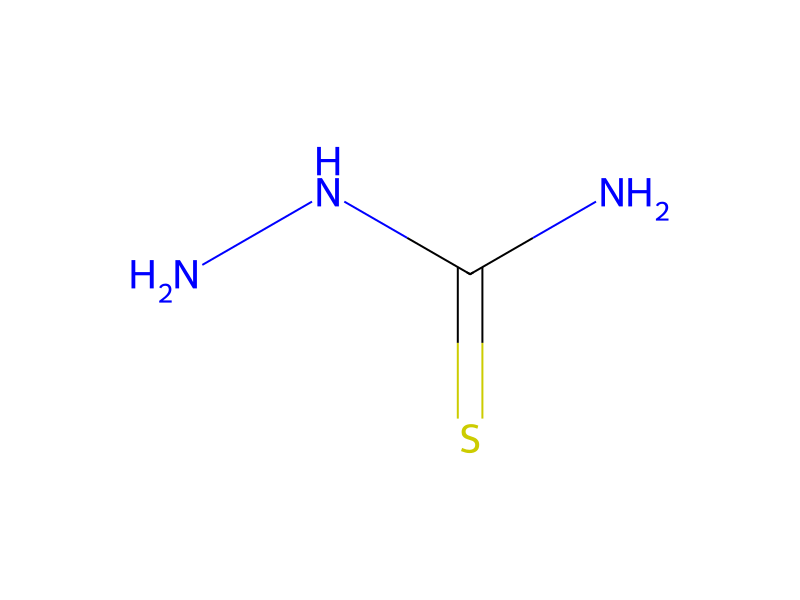


Product 1

Reagents, catalysts & solvents 1

Procedure
5 g of 4-fluorophenylacetic acid (32.44 mmol, 1 eq.) are placed in 50 mL of dichloromethane with stirring. 3.25 g of thiosemicarbazide (35.68 mmol, 1 eq.), 4.38 g of hydroxybenzotriazole (32.44 mmol, 1 eq.) and 6.22 g of 1-ethyl-3-(3-dimethylaminopropyl)carbodiimide hydrochloride (32.44 mmol, 1.2 eq.) are successively added with continued stirring at room temperature. After 18 hours at room temperature, the dichloromethane is evaporated off. The residue is taken up in ethyl acetate, washed three times with water, once with brine and three times with 1N hydrochloric acid. The organic phase is dried over sodium sulfate and evaporated to give 5 g of 2-[(4-fluorophenyl)acetyl]hydrazinecarbothioamide. M-isobutene+=228.
Workup
- stirringwith continued stirring at room temperature
- customthe dichloromethane is evaporated off
- washwashed three times with water
- dry with materialThe organic phase is dried over sodium sulfate
- customevaporated
Sources & evidence
- ORD record
- ord-2d9177aab14e435bab0c8b22c33a5a2e
- Source dataset
- uspto-grants-2013_10
- Patent number
- US08546391B2
Reaction notes
Loading…