Sodium Carbonate → 4-Phenylnaphthalen-1-amine
Reaction equation

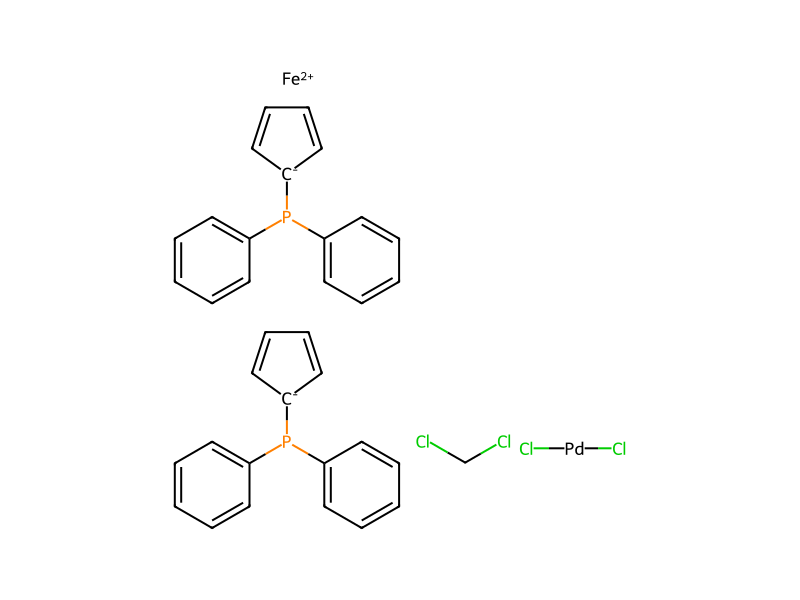
Br[C:2]1[C:11]2[C:6](=[CH:7][CH:8]=[CH:9][CH:10]=2)[C:5]([NH2:12])=[CH:4][CH:3]=1.[C:13]1(B(O)O)[CH:18]=[CH:17][CH:16]=[CH:15][CH:14]=1.C(=O)([O-])[O-].[Na+].[Na+]>C1C=CC(P(C2C=CC=CC=2)[C-]2C=CC=C2)=CC=1.C1C=CC(P(C2C=CC=CC=2)[C-]2C=CC=C2)=CC=1.Cl[Pd]Cl.[Fe+2].C(Cl)Cl.O1CCOCC1>[C:13]1([C:2]2[C:11]3[C:6](=[CH:7][CH:8]=[CH:9][CH:10]=3)[C:5]([NH2:12])=[CH:4][CH:3]=2)[CH:18]=[CH:17][CH:16]=[CH:15][CH:14]=1Participants
6
Reactant 3



Product 1

Reagents, catalysts & solvents 2

Conditions
- Temperature
- 85 °C
Procedure
A pressure bottle was charged with 4-bromonaphthalen-1-amine (500 mg, 2251 μmol), phenylboronic acid (357 mg, 2927 μmol), PdCl2(dppf)-CH2Cl2 adduct (91.9 mg, 113 μmol), 2.0 M sodium carbonate (2251 μl, 4503 μmol) and 9.0 mL of dioxane. The bottle was sealed and the mixture was heated at 85° C. for 2 h. LCMS showed desired product as the major component. The mixture was diluted with DCM and washed with water. The organic portion was dried, filtered and concentrated. The crude material was purified by silica gel chromatography, DCM to 2% MeOH/DCM to provide 4-phenylnaphthalen-1-amine. MS: [M+H]=220.
Workup
- customThe bottle was sealed
Sources & evidence
- ORD record
- ord-7199f0ae52704784ad1e14aee3bad29d
- Source dataset
- uspto-grants-2013_10
- Patent number
- US08557816B2
Reaction notes
Loading…