Hydrazine hydrate (1:1) → Tert-butyl 4-(5-bromo-3-hydrazinylpyrazin-2-yl)piperazine-1-carboxylate
Reaction equation
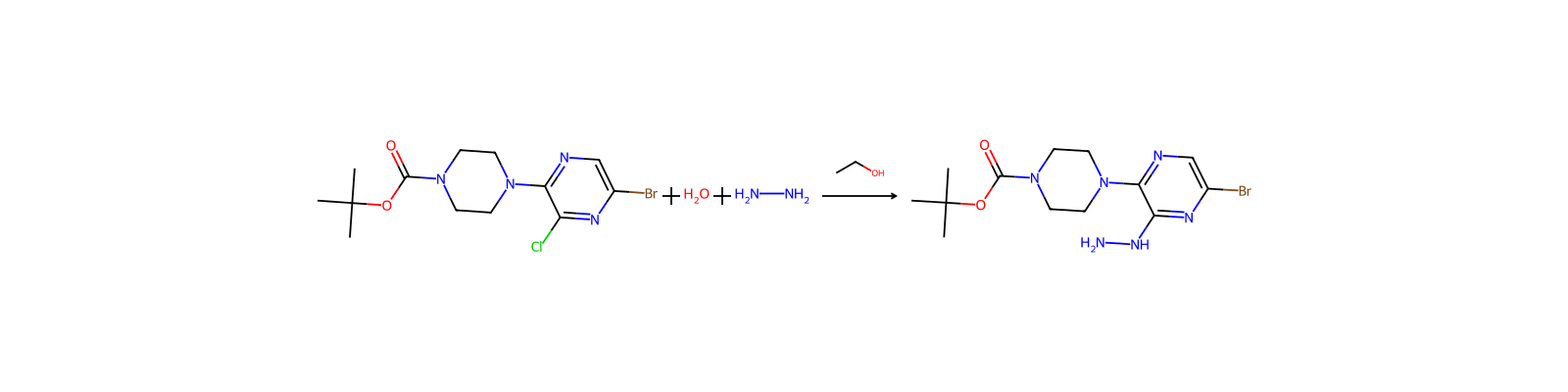
[Br:1][C:2]1[N:3]=[C:4](Cl)[C:5]([N:8]2[CH2:13][CH2:12][N:11]([C:14]([O:16][C:17]([CH3:20])([CH3:19])[CH3:18])=[O:15])[CH2:10][CH2:9]2)=[N:6][CH:7]=1.O.[NH2:23][NH2:24]>C(O)C>[Br:1][C:2]1[N:3]=[C:4]([NH:23][NH2:24])[C:5]([N:8]2[CH2:13][CH2:12][N:11]([C:14]([O:16][C:17]([CH3:20])([CH3:19])[CH3:18])=[O:15])[CH2:10][CH2:9]2)=[N:6][CH:7]=1Participants
4




Procedure
A 500 mL 3-necked round bottom flask was charged with tert-butyl 4-(5-bromo-3-chloropyrazin-2-yl)piperazine-1-carboxylate (16.1 g, 42.6 mmol), hydrazine hydrate (4.2 mL, 85.2 mmol) and ethanol (200 mL). The resulting solution was refluxed overnight. TLC indicated an incomplete conversion. The solvent was evaporated and the residue was purified by flash column chromatography on silica gel with 10% EtOAc in petroleum ether then 2% methanol in dichloromethane, to afford 5.8 g (47%) of the product as a yellow solid. MS m/z: 373 (M+H+).
Workup
- temperatureThe resulting solution was refluxed overnight
- customThe solvent was evaporated
- customthe residue was purified by flash column chromatography on silica gel with 10% EtOAc in petroleum ether
Sources & evidence
- ORD record
- ord-715da270ac714dcf8602adffb617e3c7
- Source dataset
- uspto-grants-2013_10
- Patent number
- US08569300B2
Reaction notes
Loading…