Aniline → Tricarbonylbenzene
Reaction equation

C1(N)C=CC=C(N)C=1.NC1C=CC=CC=1.[C:16]1([C:28](Cl)=[O:29])[CH:21]=[C:20]([C:22](Cl)=[O:23])[CH:19]=[C:18](C(Cl)=O)[CH:17]=1.[C:31](Cl)(=[O:34])C=C>CN1CCCC1=O.O>[C:28](=[C:16]1[CH2:17][CH:18]=[CH:19][C:20](=[C:22]=[O:23])[C:21]1=[C:31]=[O:34])=[O:29]Participants
Reactant 4
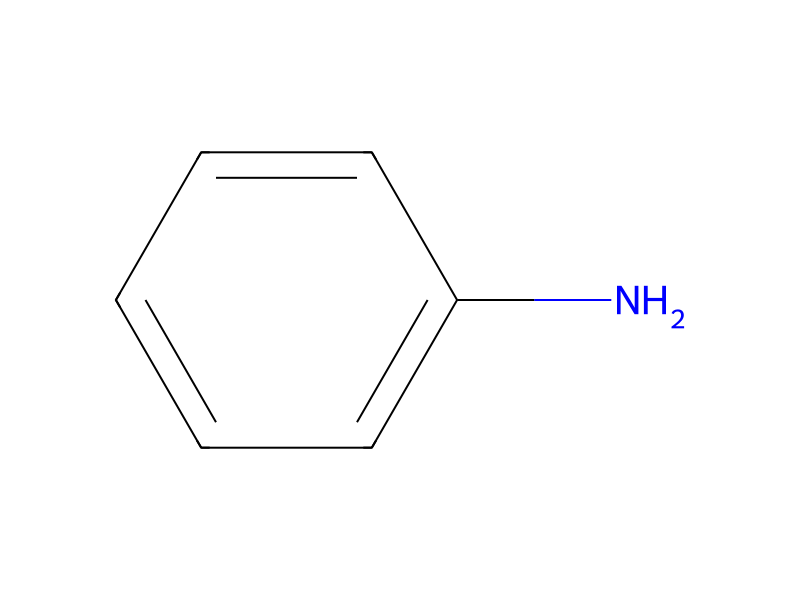

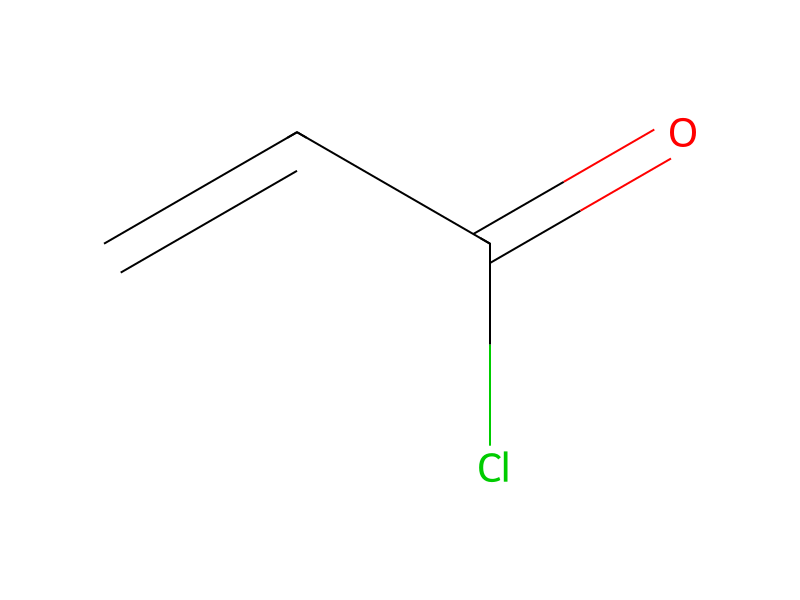

Product 1

Reagents, catalysts & solvents 2
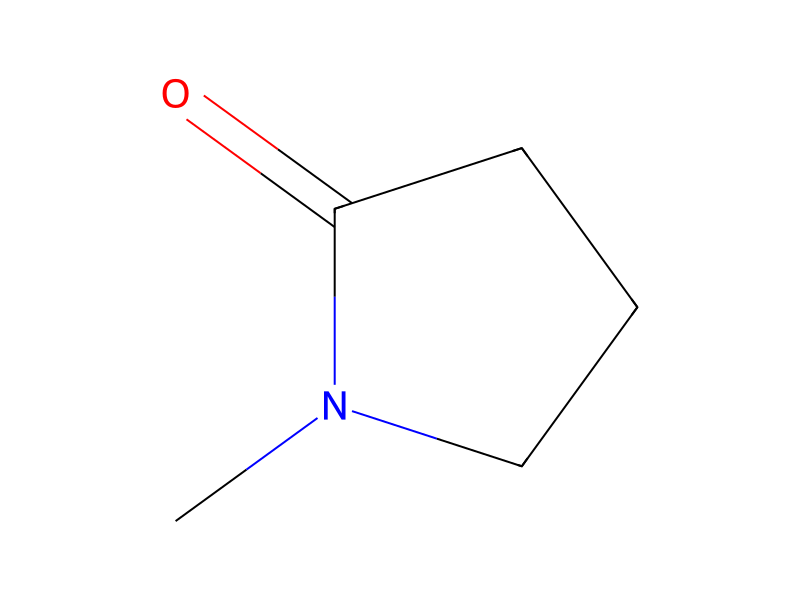
Conditions
- Temperature
- 5 °C
Procedure
In a nitrogen atmosphere, a 1,000 mL four-neck flask was charged with 20.37 g (188.3 mmol) of 1,3-phenylenediamine (DuPont K.K.), 28.06 g (301.3 mmol) of aniline (Junsei Chemical Co., Ltd.) and 250.4 g of N-methyl-2-pyrrolidone (Junsei Chemical Co., Ltd.), after which the flask contents were cooled to 5° C. Separately, in a 500 mL four-neck flask and under a nitrogen atmosphere, 40 g (150.7 mmol) of 1,3,5-benzenetricarbonyl trichloride (Wako Pure Chemical Industries, Ltd.) was dissolved in 250.4 g of N-methyl-2-pyrrolidone (Junsei Chemical Co., Ltd.), after which the solution was cooled to −20° C. and subsequently added dropwise to the amine solution at an internal temperature of 5 to 10° C. over a period of 30 minutes, thereby effecting polymerization. Following dropwise addition, the mixture was stirred for 1 hour at 10° C. or below. To this was added dropwise 27.27 g (301.3 mmol) of acryloyl chloride (Tokyo Chemical Industry) at an internal temperature of 5 to 10° C. over a period of 20 minutes, after which the mixture was stirred for 2 hours at 45° C. The reaction mixture was added to 2,000 g of pure water and re-precipitated, and the precipitate thus obtained was collected by filtration then dried at 150° C. for 3 hours in a vacuum desiccator. The resulting moist product was again dissolved in 240 g of DMAc and stirred at 45° C. for 1 hour. The DMAc solution was allowed to cool to 30° C., then added to 2,000 g of pure water and re-precipitated. The resulting precipitate was collected by filtration and dried at 150° C. for 10 hours in a vacuum desiccator, giving 52.7 g of the target tricarbonylbenzene-based hyperbranched polymer (abbreviated below as “HPmDA-Acry”). FIG. 8 shows the measured 1H-NMR spectrum for HPmDA-Acry.
Workup
- temperatureafter which the solution was cooled to −20° C.
- custompolymerization
- additionaddition
- stirringafter which the mixture was stirred for 2 hours at 45° C
- customre-precipitated
- customthe precipitate thus obtained
- filtrationwas collected by filtration
- customthen dried at 150° C. for 3 hours in a vacuum desiccator
- dissolutionThe resulting moist product was again dissolved in 240 g of DMAc
- stirringstirred at 45° C. for 1 hour
- temperatureto cool to 30° C.
- additionadded to 2,000 g of pure water
- customre-precipitated
- filtrationThe resulting precipitate was collected by filtration
- customdried at 150° C. for 10 hours in a vacuum desiccator
Sources & evidence
- ORD record
- ord-bd0aa1e5a9f746db904cb0277c0c8a0f
- Source dataset
- uspto-grants-2016_07
- Patent number
- US09382381B2
Reaction notes
Loading…