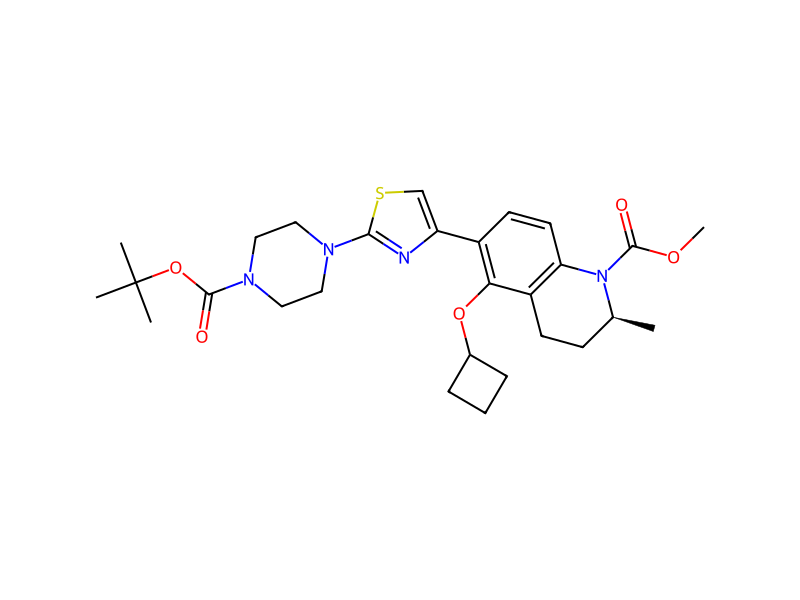
Sodium Carbonate → (S)-methyl 6-(2-(4-(tert-butoxycarbonyl)piperazin-1-yl)thiazol-4-yl)-5-cyclobutoxy-2-methyl-3,4-dihydroquinoline-1(2H)-carboxylate
Reaction equation

[CH:1]1([O:5][C:6]2[C:15](B3OC(C)(C)C(C)(C)O3)=[CH:14][CH:13]=[C:12]3[C:7]=2[CH2:8][CH2:9][C@H:10]([CH3:29])[N:11]3[C:25]([O:27][CH3:28])=[O:26])[CH2:4][CH2:3][CH2:2]1.Br[C:31]1[N:32]=[C:33]([N:36]2[CH2:41][CH2:40][N:39]([C:42]([O:44][C:45]([CH3:48])([CH3:47])[CH3:46])=[O:43])[CH2:38][CH2:37]2)[S:34][CH:35]=1.C(=O)([O-])[O-].[Na+].[Na+].O1CCOCC1>C1C=CC(P(C2C=CC=CC=2)[C-]2C=CC=C2)=CC=1.C1C=CC(P(C2C=CC=CC=2)[C-]2C=CC=C2)=CC=1.Cl[Pd]Cl.[Fe+2].ClCCl.O>[C:45]([O:44][C:42]([N:39]1[CH2:40][CH2:41][N:36]([C:33]2[S:34][CH:35]=[C:31]([C:15]3[C:6]([O:5][CH:1]4[CH2:2][CH2:3][CH2:4]4)=[C:7]4[C:12](=[CH:13][CH:14]=3)[N:11]([C:25]([O:27][CH3:28])=[O:26])[C@@H:10]([CH3:29])[CH2:9][CH2:8]4)[N:32]=2)[CH2:37][CH2:38]1)=[O:43])([CH3:48])([CH3:46])[CH3:47]Participants
Reactant 4




Product 1
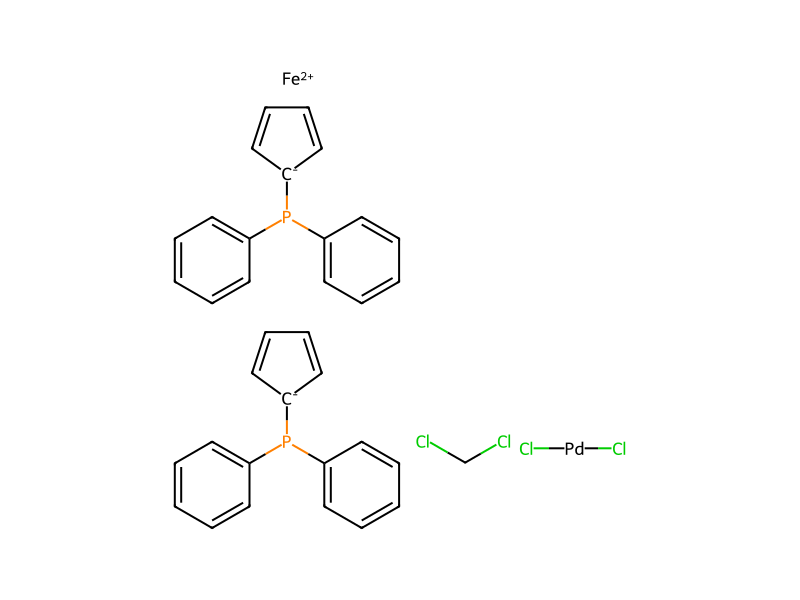
Reagents, catalysts & solvents 2

Conditions
- Temperature
- 80 °C
Procedure
A 50-mL round-bottom flask was charged with (S)-methyl 5-cyclobutoxy-2-methyl-6-(4,4,5,5-tetramethyl-1,3,2-dioxaborolan-2-yl)-3,4-dihydroquinoline-1(2H)-carboxylate (0.080 g, 0.20 mmol), tert-butyl 4-(4-bromothiazol-2-yl)piperazine-1-carboxylate (0.083 g, 0.24 mmol), sodium carbonate (0.042 g, 0.40 mmol), [1,1′-bis(diphenylphosphino)ferrocene]dichloropalladium(II) dichloromethane adduct (0.081 g, 0.10 mmol), 1,4-dioxane (10 mL) and water (3 mL). The resulting mixture stirred for 4 h at 80° C. The reaction mixture was cooled to room temperature, filtered through a short pad of Celite, and the filtrate was concentrated under vacuum. The residue was purified via preparative thin layer chromatography (eluting with 10:1, dichloromethane/methanol) to afford (S)-methyl 6-(2-(4-(tert-butoxycarbonyl)piperazin-1-yl)thiazol-4-yl)-5-cyclobutoxy-2-methyl-3,4-dihydroquinoline-1(2H)-carboxylate (0.070 g, 64%) as a light yellow solid. MS (ESI, pos. ion) m/z 543 [M+H]+.
Workup
- temperatureThe reaction mixture was cooled to room temperature
- filtrationfiltered through a short pad of Celite
- concentrationthe filtrate was concentrated under vacuum
- customThe residue was purified via preparative thin layer chromatography (eluting with 10:1, dichloromethane/methanol)
Sources & evidence
- ORD record
- ord-c92e739e97b241c68ce15eeb97781cfc
- Source dataset
- uspto-grants-2016_07
- Patent number
- US09388161B2
Reaction notes
Loading…